How can communications studies contribute to anthropological inquiry of Syria? This essay reflects on the architecture that governs silence and speech in a country that is transformed by volatile and extreme violence and the material and emotional wounds that that entails. The expression “walls have ears” resonated well under Al-Asad(s). For decades, Syrians invoked the metaphor to discipline themselves and each other. In a country where the manufacturing of silence was a form of governance (Ismail, 2018), people were so fearful of speaking out that they instinctively whispered, even in their homes, if they judged what they were about to say as politically sensitive. What they often whispered was humour used to poke fun at themselves (Wedeen, 2015).
One joke I remember from the 1990s when neighbouring Lebanon was emerging from civil war is about a Syrian dog who travels to Beirut to visit his cousin after many years apart. The Lebanese dog was thin, ate out of dumpsters but was happily wagging its tail, the Syrian dog was well-fed but miserable and lethargic. Bewildered, the Lebanese canine asks ‘What’s wrong with you! You are well-fed and live in peace!’ The Syrian dog looks at him with sad round eyes, and after some silence, lets out a long, loud cry “I just want to bark!!!”
In the mentioned expression and joke, we imagine the Al-Asad regime in the form of big transparent ears on every Syrian wall, and Syrians as treated like dogs suppressing their barks. The system of oppression, and the relation between fear and speech, could not be clearer in these imaginings.
we imagine the Al-Asad regime in the form of big transparent ears on every Syrian wall, and Syrians as treated like dogs suppressing their barks
Understanding Syria’s governance through silencing recalls the 2011 uprisings which sought to honour those who broke the silence. One of the first protests in Damascus consisted simply of people chanting “no more fear; after today, no more fear”. Protestors collectively uttered these words before articulating anything else. Aware of the life and death consequences, these protestors embodied defiance. Many Syrians, then and now, acknowledge the debt owed to such courageous acts that, after a war soaked in blood, led to this moment.
Let us then consider this moment. In December 2024, developments unfolded fast. In one week, the HTS (Hay’at Tahrir Al-Sham) launched a fateful offensive. By 8 December, Bashar Al-Assad had fled the country ending 53 years of his family’s rule. That year had been devastating. Israel was continuing its genocidal war against Palestinians in Gaza that by then had killed more than 45,000. Lebanon had just agreed to a ceasefire following a crushing war with Israel that saw the re-occupation of parts of the South. Amid all this, Syrians reacted with disbelief and emotional intensity. There was much concern about the future (one particularly thinks of minority communities from Kurds to Alawites). But there was also joy, and lots of it.
There was joy in finally filling the streets and freely singing and dancing in public squares. There was joy in lashing out at Bashar Al-Asad and at the memory of his despised father. If we go back to the dog and the joke, one imagines it jumping high in the streets and barking in public after so long. Social media pages burst with celebration, fueled by leaked photographs of the former dictator in his underpants. As he was stripped of authority, the viral spread of these images, and their manipulation through Photoshop and AI generated videos, stripped him of clothing and masculinity as well.

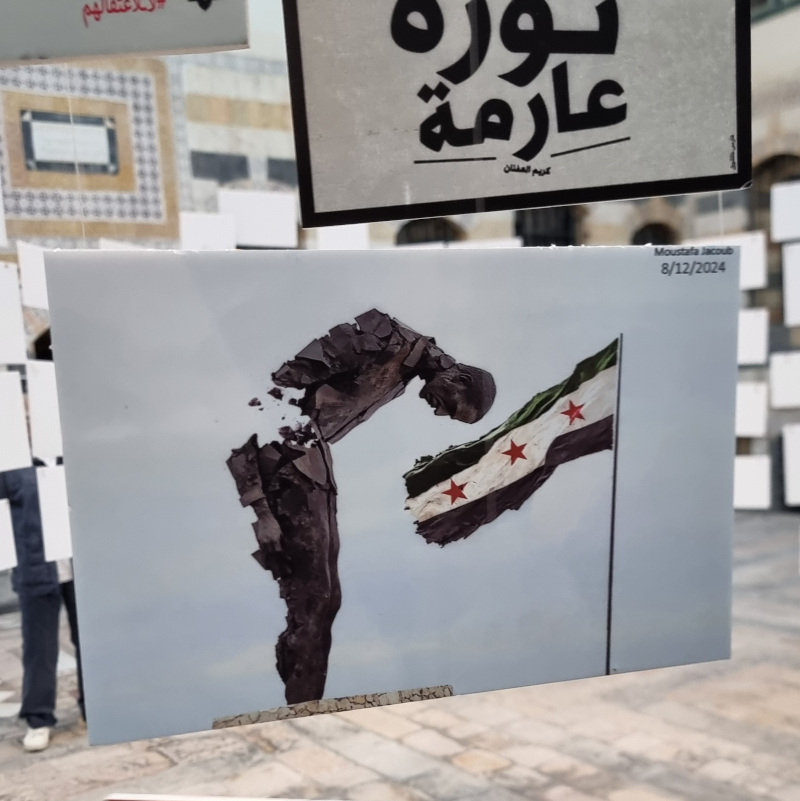
“Exhibition about the revolution in Beit Farhi, Damascus, April 2025,” Photo by author.
However, silence and speech are not a binary (nor are sadness and joy). As Syrian publics dramatically reconfigured as they coalesced around new texts and power configurations, they faced the challenge of holding space for the words and emotions of those they disagreed with. The joy of speaking out co-existed with long suppressed expressions of mourning and anger over lost loved ones: those who perished in torture centres and in war crimes. Syria’s new rulers’ preferred tune, however, is a joyful unquestioning support regardless of how loud the shrieks of pain or drums of war get, including with continued Israeli strikes and aggressions.
By March 2025, Syrian joy sadly got tainted with Syrian blood. Following clashes between militants loyal to Al-Asad and the new security forces in coastal areas, hundreds of civilians were massacred in revenge killings. As “security forces” returned to their status as Islamist militants, the word massacre returned to the Syrian lexicon. Videos of torture and killings in cold blood also resurfaced in the digital sphere. One such video shows an exchange between an Alawite mother and militants. The bodies of her two slain sons in front of her, a militant addresses her: “This is because you betrayed us”. She looks at him with contempt and breaks her silence saying, “you lie” (fashart).
The joy of speaking out co-existed with long suppressed expressions of mourning and anger over lost loved ones
On 12 March, the horrified silence of Alawite communities was interrupted by the bangs and booms of fireworks hailing a new agreement between the new President Ahmad Al-Sharaa and Kurdish authorities. It is as if the joy of the celebration of averted potential bloodshed can drown out the fresh cries of despair over just spilled blood. This is one way that what is to be remembered or forgotten is redrawn along the boundaries of what is silenced or amplified.
Ancient history is not spared, such as in attempts to mute references to iconic Zenobia, the third-century Palmyrene queen, by removing her from school curricula. While the figure of Muawiya, the 7th century Umayyad caliph starring in a slick new historical Ramadan TV drama, becomes a resurrected source of inspiration. With that, nostalgia for Umayyad history shifts from a reflective to a restorative sensibility (Boym, 2001).
On digital platforms, 2025 is a different era from 2011. The days when Facebook and Twitter/ X could simply be thought of as public forums are gone. As US tech billionaires align with fascist ideologies, algorithms are deployed to govern speech via echo chambers of division, untruth, surveillance and profitability. Indeed, these platforms are spaces that amplify what they think people already want to hear and, by design, they filter out what is coded as noise.
Central Damascus, as the preferred broadcast media frame through which to portray Syria, prescribes both the visions and sounds of a nation-state threatened by division.
Syria’s new rulers seem to be listening to digital platforms. They respond to public outcries and claim to change policies that prove unpopular. This performativity of accountability distracts from building a communications infrastructure based on media freedoms and pluralism. Distraction is intrinsic to governance in the new Syria where local critical journalists get ignored, while influencers and content creators were Al-Sharaa’s early guests. Central Damascus, as the preferred broadcast media frame through which to portray Syria, prescribes both the visions and sounds of a nation-state threatened by division.
So, yes, walls still have ears, and ears have walls. These walls can no longer be imagined as stable and static. They are shape-shifting systems of surveillance that structure speech and silence and drive emotions that reconfigure publics. Understanding this is crucial for Syrians as they hustle for a role in rebuilding their country. It is also important for anthropologists to tune into these possibilities and limitations of speech as they study this new Syria.
Abstract: In Syrian memory, walls were said to have ears. In living rooms, on phone calls, people lowered their voices, spoke in code, or changed the subject when it came to politics. During the revolution, speaking out was a dangerous act of defiance. But what now? This essay reflects on the joys of speaking out after decades of silencing, but also on new boundaries, possibilities, and violence embedded in political speech online and offline in the new Syria.