

Yael Berda. 2022. Colonial Bureaucracy and Contemporary Citizenship: Legacies of Race and Emergency in the Former British Empire. Cambridge: Cambridge University Press.
In Colonial Bureaucracy and Contemporary Citizenship: Legacies of Race and Emergency in the Former British Empire, Yael Berda connects the political life of documents in postcolonial state administrations to the organizational legacies of British colonial rule. Her comparative study of India, Cyprus, and Palestine/Israel reveals the empire-wide circulation of administrative technologies, from censuses and permits to blacklists and loyalty vetting committees. Across these cases, she traces how mundane bureaucratic routines moved from colonial to postcolonial regimes. Bureaucracy, in her account, does not merely enforce the law. Rather, it actively subverts it, becoming a toolkit for enacting violence in the language of order.
Berda’s book pursues three ambitious goals. First, it highlights the central role of mundane colonial bureaucratic practices in shaping political outcomes. Second, it offers a synthetic model of English colonial bureaucracy and its transmission into postcolonial administrations. Third, it proposes a double comparison of bureaucracies—between colonial and postcolonial regimes, and across three postcolonial states. This double lens sheds light on how everyday practices shape two state-building arenas: the citizenship of minorities and the management of civil servants. Structured in three parts and five chapters, the book provides timely insights into how postcolonial bureaucracies classify, immobilize, and exclude, in the name of governance, practices that continue to shape today’s political landscapes.
Rejecting the view that colonial administration was chaotic or improvised, she argues that it was systematic, defined by racial profiling, exception-making, and emergency rule.
Part I, Hybrid Bureaucracy: How Race and Emergency Shaped the Organization of Colonial Rule, opens with a conceptual intervention. It reframes the Weberian model of bureaucracy by examining its transformation in colonial contexts. Berda theorizes “hybrid bureaucracy” as an imperial formation that fuses rational-legal principles with racialized emergency governance. Rejecting the view that colonial administration was chaotic or improvised, she argues that it was systematic, defined by racial profiling, exception-making, and emergency rule. Drawing on archives and theory, Berda challenges the assumption that colonial bureaucracies lacked coherence. This foundational chapter grounds the book’s argument: racial and security logics were not deviations but core features of colonial administration.
Part II, The Axis of Suspicion: Classifications of Identity and Mobility in Crises, deepens the analysis. It shows how bureaucratic classifications shaped identity and restricted movement in India, Cyprus, and Palestine. Chapter 2 focuses on the colonial census as a tool of population management. It reveals how demographic categories, first framed as neutral, hardened into ethno-national distinctions used to allocate resources and reinforce majorities. Chapter 3 explores the evolution of bureaucratic emergency tools like blacklists, disturbed area classifications, and permit regimes. The “axis of suspicion” (92) emerges as a powerful concept, showing how fear and suspicion drove the reclassification of populations. Bureaucracy, here, does not only respond to threats: it also produces a perpetual emergency.
Part III, Administrative Memory and the Legacies of Emergency, turns to post-independence. It explores how colonial bureaucratic tools were inherited, revived, or reconfigured by new states. Chapter 4 analyzes how civil services in Israel, India, and Cyprus reproduced colonial distinctions under national rule. Through loyalty vetting, anti-corruption campaigns, and quotas, bureaucracies defined who was eligible to serve the state. Chapter 5 focuses on mobility regimes and evidentiary demands on returnees and refugees. Emergency laws transformed bureaucracies into gatekeepers of citizenship. This section demonstrates that postcolonial states did not break from the colonial past. Instead, they extended it, with citizenship emerging not as a set of rights, but as a regime of regulated mobility.
Berda reveals the persistence of legal liminality, the bureaucratic production of suspicion, and the transformation of citizenship into a system of control.
The strength of Berda’s analysis lies in her ability to bridge past and present through the lens of organizational institutionalism. Bureaucratic regimes forged under empire did not vanish with independence. They were adapted and institutionalized. In India, refugee registration systems developed under the Raj were used to manage post-Partition populations. In Israel/Palestine, British permit regimes formed the basis of military occupation. Cyprus repealed colonial emergency laws but soon descended into civil war. These cases show how colonial scripts are not only inherited but reactivated. Berda reveals the persistence of legal liminality, the bureaucratic production of suspicion, and the transformation of citizenship into a system of control. Her work helps us understand the postcolonial state not as a rupture, but as a continuation of administrative warfare.
While rich in archival detail and institutional insight, the book’s narrative is largely told from the vantage point of bureaucratic actors. We may regret that the voices of those targeted by these systems — the classified, the dispossessed, the immobilized — remain largely outside the frame. As such, the analysis sometimes risks reinforcing the coherence and omnipotence of the state apparatus it critiques. Yet Berda’s methodological choice to “look over the shoulder of the bureaucrat” (34) from the perspective of colonial officials offers a sharp critique. It shows how discretion, suspicion, and categorization are normalized. The book invites us to reflect on how bureaucratic infrastructures shape legitimacy, deservingness, and risk. Its insights are relevant wherever administrative categories replace political dialogue.
One of the book’s aims is to define a general model of English colonial bureaucracy and its transmission. Yet we are left wondering how generalizable the “hybrid bureaucracy” (18) concept is. Does it apply across the British Empire? And how does it compare to other empires like the French, Portuguese, or Dutch? The concept may be less useful for understanding more fragmented African colonial contexts or the Gulf states, where dynastic-patrimonial rule and labor migration regimes like the kafala system have shaped distinct forms of exclusion and mobility. Expanding Berda’s comparative framework would require closer attention to the political economies of extraction, indirect rule, and settler colonialism. It would also need to consider the enduring role of precolonial bureaucratic traditions. By focusing primarily on the colonial period, the book risks erasing how precolonial legacies shaped administrative expectations, forms of belonging, and resistance.
In closing, Berda poses a crucial question that remains open: what do bureaucratic legacies tell us about the possibility of imagining other futures?
Colonial Bureaucracy and Contemporary Citizenship is a vital intervention for understanding the violence of settler and postcolonial regimes. It shows how bureaucratic rationalities sustain contemporary bordering practices, from biometric surveillance to permit regimes to the administrative division of Indigenous territories. Berda closes with a striking claim: citizenship in postcolonial states functions as a mobility regime. Expanding this idea means recognizing that legal belonging today is mediated by control rather than protection. One’s ability to stay, move, or return depends on evidence and discretion, not stable rights. This redefinition reframes citizenship not as a political status, but as a precarious condition governed by bureaucracy and emergency logics. Berda shows how micro-practices — forms, permits, suspicion lists — draw the boundaries of belonging. Her framing of citizenship as non-deportability has wide-reaching implications. It challenges us to see citizenship not as a right but as an effect of circulation, suspicion, and immobilization.
In closing, Berda poses a crucial question that remains open: what do bureaucratic legacies tell us about the possibility of imagining other futures? In a world marked by ethno-nationalism, legal apartheid, and climate displacement, Berda’s institutional and postcolonial lens urges us to scrutinize the bureaucracies that sustain inequality and to imagine alternatives. Her background as a human rights lawyer adds depth to her analysis, informing her institutional knowledge and critical distance. This book is a necessary contribution to debates on empire, citizenship, and the state. Its historical reach, comparative scope, and conceptual clarity will interest scholars of legal anthropology, settler colonialism, and global governance.
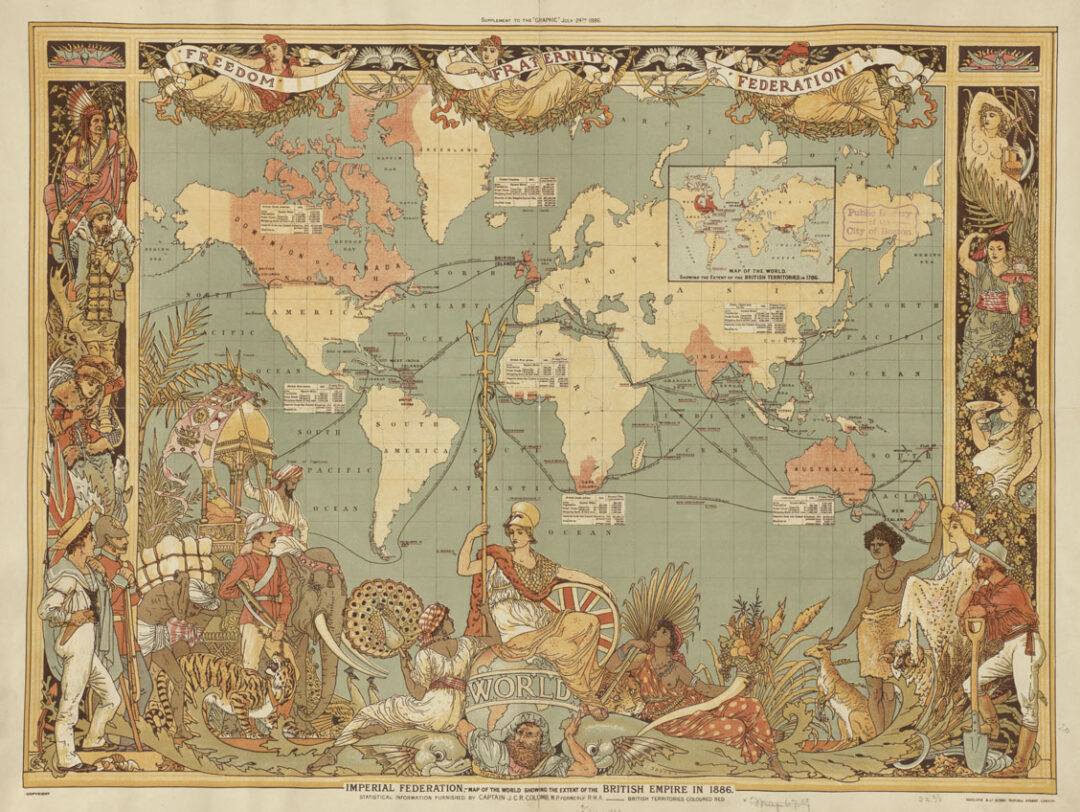
Featured Image: Imperial Federation, map of the world showing the extent of the British Empire in 1886. Source: Wikimedia.