

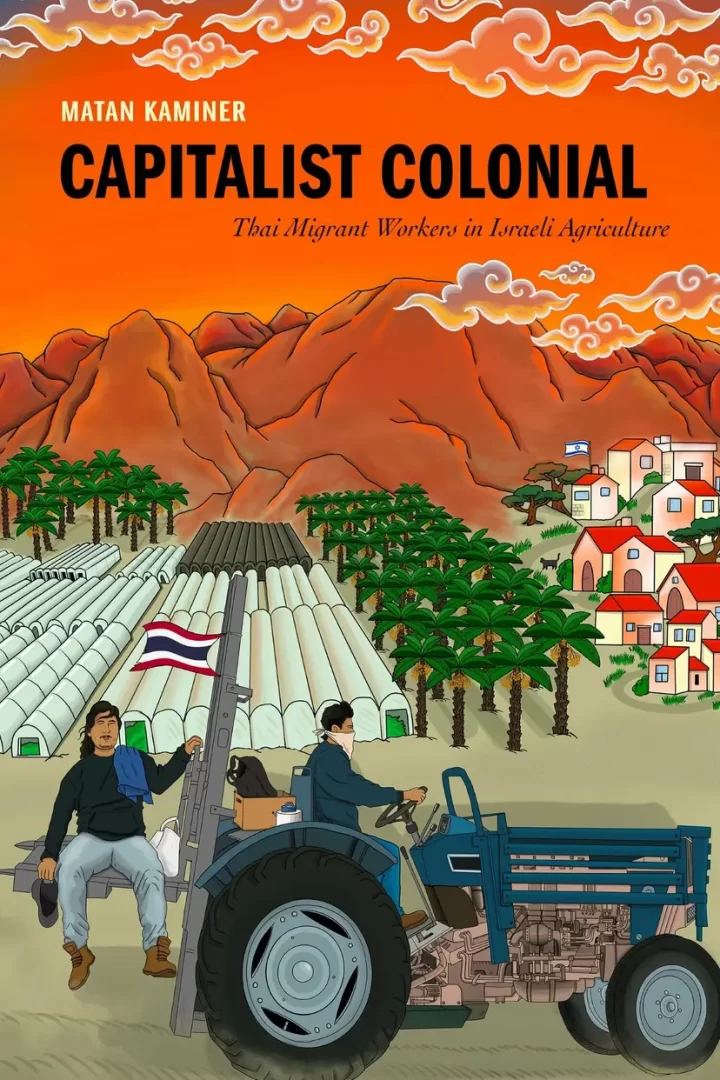
Matan Kaminer. 2024. Capitalist Colonial: Thai Migrant Workers in Israeli Agriculture. Stanford: Stanford University Press.
Matan Kaminer’s new book is about the Thai men and women who have worked in Israeli agriculture since the 1990s. If most of that sentence is news to you, you’re not alone. The stories of Thai workers are rarely covered by the media, and almost all scholarship on the region, from the conventional accounts to far more radical framings, primarily focuses on Israelis and/or Palestinians. This invisibility, we learn, is inseparable from the very ways that Thai workers are incorporated into the agricultural sector and excluded from public life during their time in Israel. Kaminer’s book does not so much “go beyond” the national question, and attendant struggles over territory, sovereignty, and belonging, so much as he looks at the lives that are lived and lost alongside it. The stories and experiences of Thai workers, he shows, have much to teach us about the workings of settler colonialism and capitalist domination in the world today.
The narrative of Capitalist Colonial is straightforward enough, with Kaminer beginning by explaining how Thai workers ended up in Israel before getting into the details of what their lives are like on and off the farm. The first half of the book relies on a combination of interviews, archival materials, and secondary literature to tell the story of Israeli settler colonization (in particular in the Arabah, an arid region in central Israel that is home to commercial vegetable farms created by the “labor settlement movement”), the agrarian and political history of Thailand (in particular rural Isaan, a region in northeastern Thailand where migrant workers hail from), and how after the 1990s these workers were conscripted into a capitalist colonial project spanning the two countries. The second half of the book is based on participant observation (Kaminer worked on a vegetable farm in the Arabah), and interviews with workers, bosses, and other relevant actors in Israel and Thailand. It covers the agricultural labor process, the forms of containment and exclusion that Thai migrants experience when they are not on the clock, and their relationships with parents, spouses, and children back in Thailand. The early chapters aren’t there just to set the scene for the real ethnographic stuff; instead, as Kaminer shows us, histories of colonization, capitalist development, and revolt inform the ideologies and values of Israeli settlers and Thai workers who together shape the specific forms that domination takes in Israeli agriculture today.
This book raises many important points. I suspect that other readers—perhaps those that study migration, for example—might gravitate towards different themes. But as a scholar who is invested in agrarian studies debates and works primarily with Palestinians in the West Bank, three stand out to me: what Kaminer tells us about settler colonialism, his framing of labor and domination, and what this all means for the kinds of political thinking that anthropology can contribute to.
First, Kaminer gives us a perspective that is missing from most accounts of Israel/Palestine that have emerged from the settler colonial and Indigenous studies line of scholarship. In the midst of the First Intifada (1987-1993), the Israeli authorities began to decrease (but could never quite kick) the state’s dependence on now-rebellious Palestinians by replacing these workers with migrant labor. Kaminer is far from the first person to point this out, of course, but reading this book made me realize that while there has been a lot of excellent scholarship on the fate of Palestinian workers, there has been far less interest in the people who were brought in to replace them. One of the most fascinating parts of Capitalist Colonial is Kaminer’s account of schemes to export the Israeli model of agricultural colonization to Thailand. These efforts did not result in Israeli-style settlements on the Thai frontier; they did, however, create the relationships and know-how that ultimately facilitated the flow of Thai workers into Israeli farms. As Kaminer argues, Thai labor is especially conducive to keeping what remains of the labor settlement movement afloat in the region, at least for now. But he also points out that the very ability for Israeli and Thai elites to have had a “mutually intelligible conversations about ‘frontier settlement’” tells us something important about how ruling classes imagine controlling peripheral regions, and the centrality of “capitalist colonial domination” to these efforts (56). It is this latter argument that I find especially helpful, since it prods us to reconsider earlier Israeli attempts at soft-power through agricultural development, and might help us make sense of efforts underway to extend Israeli diplomatic and economic power through digital agriculture, environmental consulting, and other such projects in Asia, Africa, and elsewhere in the Global South today.
And, most importantly, Kaminer again insists on what people bring with them: for Thai workers, this includes generational experience of working in Israel as well as practices and expectations informed by vernacular Buddhism, rural political culture, and obligations to kin back home.
This gets us to a second major contribution of the book, which emerges from Kaminer’s discussion of labor. He argues that Thai workers do two distinct kinds of work. The first is in the fields, and his workplace ethnography asks to consider the work not only of picking vegetables, but also of how “bodily appearance, including not only skin color but also clothing, body hexis, and working pace” shape the labor process and index racial difference (101). The second is what they do, or more precisely, what they do not do, to appear unthreatening to both the ideology of labor settlement and the Jewish public. Kaminer insists that we should see this as uncompensated work (147). And while this is one of the rare points in the book where I am not quite sure what we gain analytically by understanding shopping in certain shops and not others, or refraining from using public amenities like pools as “work”, what is clear is that navigating Israeli public spaces involves skill, knowledge, and discernment. And, most importantly, Kaminer again insists on what people bring with them: for Thai workers, this includes generational experience of working in Israel as well as practices and expectations informed by vernacular Buddhism, rural political culture, and obligations to kin back home.
This approach gives us a set of concepts that help us make sense of the complex forms of power that we gloss as domination. Capitalist Colonial is about the world system, one that consigns millions to the fate of cheap, peripatetic labor. But what this book gives us, and what good anthropology can offer to our understanding of this massively complex and multifaceted thing we call “global capitalism,” is an attention to the ways that people make sense of their condition, and what they do about it. Thankfully, Kaminer steers clear of searching for resistance or celebrating agency. Instead, we have a range of concepts and discussions—the limited types of autonomy that workers carve out during work, the specific ways that migration regime imposes strictures on both workers and employers, the “discreet” transcripts of anger at exploitation—that help us understand how power works. And they also help us understand what dignity and freedom might look like for these workers, who are grappling with injustices in and outside of the workplace, the challenges of maintaining their obligations to kin back home, and hopes for a good life that years sacrificed working in Israel might help them to achieve.
If anthropologists wish to say anything of political importance about Israelis, Palestinians, Thais, and the others who, by choice or not, live between the river and the sea, continuing “the project of picking hopeful strands out of the jumbled knot of ideologies” (xv) seems to me to be a good place to start.
It is this commitment to understanding how domination is lived that will allow the theoretical and methodological lessons of Capitalist Colonial to travel. This is not a book whose critical move is to reveal the predations of the boss or the suffering of the worker and to call for more law or better enforcement. Even the “dominant strands of human rights discourse,” Kaminer points out, posit “migrants merely as subjects worthy of protection, not as ones eligible for full membership in the polity” (171). Whether one finds his hope for “a decolonized, democratic, socialist Arabah shared by Bedouin, Jews, and Isaanites” powerfully inspiring or hopelessly idealist might for now be beside the point. After Palestinian fighters killed and kidnapped Thai workers on October 7, thousands left the country. The subsequent genocide that Israel unleashed on Gaza, accompanied by violent land grabbing in the West Bank and an ever-expanding series of invasions, assassinations, and bombings across the region, have probably crushed whatever fleeting of democratic possibilities existed in places like the central Arabah. Two years on, the unrestrained annihilation of Gaza has only underlined that a political critique that rests on the promised protections of the law or human rights is insufficient. If anthropologists wish to say anything of political importance about Israelis, Palestinians, Thais, and the others who, by choice or not, live between the river and the sea, continuing “the project of picking hopeful strands out of the jumbled knot of ideologies” (xv) seems to me to be a good place to start.
Finally, I’d like to end with a few words on how this book reads, and who might benefit from reading it. Kaminer is theoretically rigorous, but he writes with a light touch (the citations and relevant academic debates are helpfully corralled into endnotes). There is also an attention to storytelling and narrative variation: revealing the political drama and scheming behind the ill-fated frontier settlement project in Thailand, anchoring the discussion of the labor process in a single working day, or exploring the transnational dynamics of migrant labor through life stories of a few people. This is an engaging book, and one that is written to be read front to back. If you have time to teach it like that, great. But if you don’t (or if your students will revolt if you ask them to read an entire book), other paths are possible. I can imagine, for example, assigning the introduction and the fourth chapter for a week in my Food and Justice course, or the second and fourth for my class on Israel/Palestine. Capitalist Colonial is a book that deserves to be read and debated, but most importantly, taught widely. I’m looking forward to doing so.
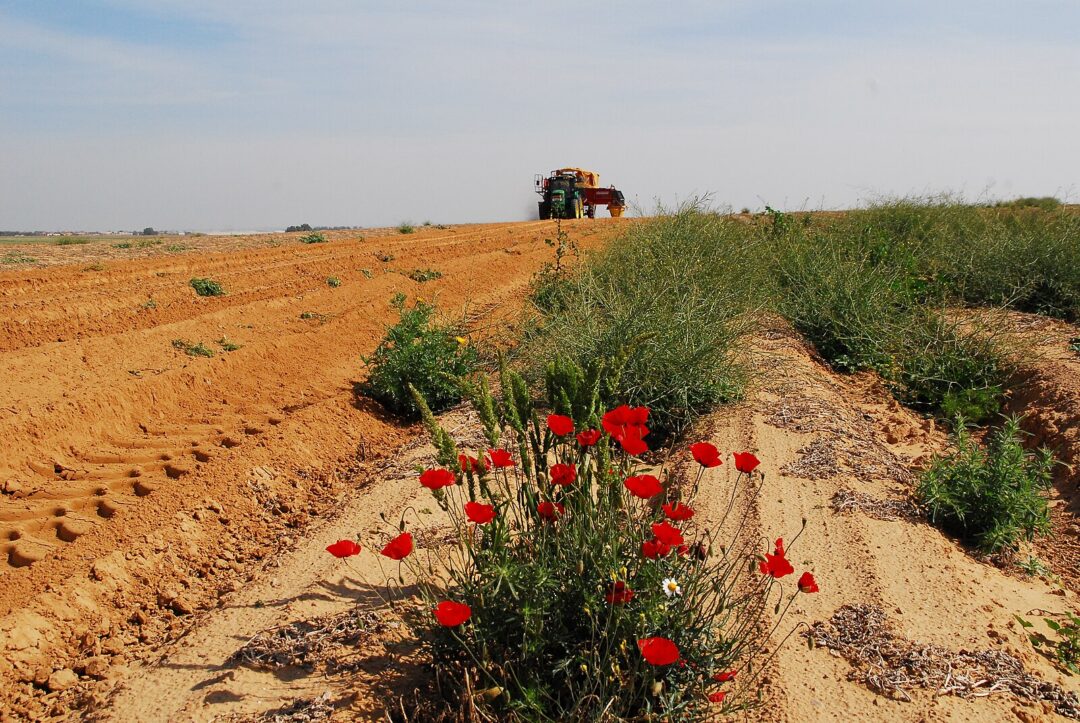
Featured Image: Pikiwiki Israel 19698. Source: Wikimedia.