In this final episode, the conversation turns to advocacy – what it means to do it from within a country shaped by donor dependency, short-term project cycles, and the structural inequalities discussed in the previous episode. Drawing on seven years of experience, participants reflect critically on why most funding for migration-related civil society work comes from European organizations whose primary interest is keeping people from reaching Europe, and what gets lost when programs arrive already designed, with local actors reduced to implementers. The episode questions whether sensitization campaigns can ever meaningfully address migration as long as the conditions driving it remain untouched, and confronts the mounting human toll of deportations – particularly from Germany -on individuals, families, and communities left with no psychological support and no material safety net. It closes not with easy answers but with a collective demand: for self-determination over aid dependency, for long-term structural investment over project cycles, and for an honest reckoning with who benefits from the current system, and who pays for it.
Transcript of Episode 7: Advocacy
Footnotes by Viola Castellano
Intro:
My name is Tijan Jerju, Fatou Cham, my name is Fatou Darboe, Fatou Bojang from Gambia, Lamin Kotta, my name is Saikou Tunkara.
Viola
I am Viola Castellano and this is Backway to Europe: Talking Borders and Migration with Gambians on the Move. This podcast series is produced in collaboration with Gambian advocates and activists. It centers their analyses of the border regime through their direct experiences of “the backway”—the local term for the illegalized route to Europe. These experiences resonate with many who have attempted to reach Europe across West Africa and beyond. In the next seven episodes, you’ll hear from members of Youth Against Irregular Migration (YAIM) , an advocacy organization founded by young Gambians who met in a Libyan detention center. The topics and discussions emerged from years of collaboration and are rooted in their advocacy work. I use my research as an anthropologist working on border externalization to provide context and put my findings in dialogue with YAIM’s reflections.
Welcome to the final episode of our series. Today, we’re taking a step back to reflect on what it really means to advocate for migration issues here in The Gambia – something the members of YAIM have been doing since 2017, after returning from Libya. Their journey brings us to a bigger conversation: why do European NGOs and agencies fund sensitization campaigns and support civil society organizations? And why do so many of these short-term partnerships struggle to create real, lasting change? As deportations from the EU increase1, we also take a hard look at what it means to return home – often forcefully and empty-handed – and the deep social, economic, and psychological toll that takes. So in this final episode, we ask: what will it take to build a future for young Gambians? And why do we need new forms of engagement and collaboration to make that future possible?
Saikou
Most of us, we meet in prison. So being in prison there, after we realize that we will go back to our country, they will deport us to our country. So one of our K-Bama, our elder brother, is there we call him K-Bama. So he came with this idea when we came back to our country, we don’t have to sit and fold our hands together. We have to try our best to communicate with people, the difficulties that are in this irregular migration, to explain to them. So that’s why we came with this idea, and when we came back in 2017, we tried to register.
Viola
YAIM registered as a civil society organization and started to move around the country talking about their experiences in the backway, but not only
Saikou
We also talk about the challenges that the returnees are facing in their in their country back in Gambia you know yes but the organization is not only about for the returnees not only the returnees but also the potential migrants, because those are the people we want to discourage not to go to this irregular migration. But not only advocating or not only to say that don’t go don’t go how we can we can change things or the things that are making our people to leave how we can we can have those things in Gambia here and all sort of empower our young people here
Fatou Darboe
I’ve been a volunteer before I’m a volunteer of the Gambia Red Cross Society so volunteerism and advocacy is part of me so when I heard about them I said okay let me give you the chance and listen to what they have to say but when I came close to them I know what they are what the association is about what they are doing and everything I was interested because even though I am not I’m directly affected with them with backway or illegal migration I am affected indirectly, because my relatives have been through this journey. You know the Gambia we believe that we are all families one way or the other I have been affected through the back way.2
Saikou
Yeah the time we came it was it was not easy, it was tough, you know, but luckily we had our first advocacy project where we have supported from from the German counselor you know he supported us to do nationwide caravan sensitization to talk to the people about this regular migration.
Over the years, YAIM has worked on projects with a range of both local and international partners – from the German and Italian cooperation agencies, to the Gambian Immigration Department, the Chamber of Commerce, and the National Youth Council. They’ve rolled out sensitization campaigns through theater, cinema, and radio – using storytelling to connect with people. Today, they’re collaborating with a Dutch agency called Football for A New Tomorrow, FANT3. Through football tournaments, they’ connect with young Gambians to discuss migration and opportunities at home
Tombong
They also tell the people or the audience some of the available opportunities they have for young people in the country, because not only are telling them not to embark on this regular migration journey, because at some point you will talk to them, you will talk to young people about let’s stay back our country here,we can do it here, we can make it. But most of the frequent questions that they will ask you, what are some of the things that we can do, what are some of the things we can hold on to say like we can stay in our country. This is something that they normally ask and this is something that they are more concerned about. So this way we also go with these kinds of partners, and so they tell the young people what some of the opportunities they have within their institutions that young people can easily get access to.
But also we challenge the government to ensure young people, the needs of young people are addressed within the country and then we also use different platforms, and so we amplify our voice and then to reach out to the larger population or audience that we can all benefit from this initiative. And then recently we send young people to schools after having chapters across the country, in different regions in the country here. So each of these regions we have beneficiaries that are going to school and then with the help of our partners, FANT, Football for New Tomorrow, that we are able to send these people to go and have some skills, which are IT, human resources and also English proficiency. That we can have a sustainability in each of these skills that we are adventuring into. And also we are encouraging the partners, the international donors or international agencies and also even in our CSOC to come together and then we can do this collectively, we believe.
Viola
So I asked YAIM members a question that had been on my mind: why do they think most of their funding and collaborations come from European organizations?
Fatou Darboe
My own perspective is because they are the ones who are interested in it more. You know, all those living in Africa going, all their destination is Europe. So supporting it is for them to stop the migration, that is why they are the ones supporting it more than our own people and everything.
Saikou
Because we see that this is not only affecting Africans or Gambians, this migration, people moving from Gambia or Africa to backway to go to Europe is also affecting them. So that’s why they are supporting also because we are here, we are doing our part to go to the people, telling our stories, but they also are supporting to make sure we have a means in terms of financial support for our targets to do this advocacy. Because our Gambia government is very rare for them to support this kind of programs because they will tell you that there is no money. Most of these groups, these organizations, civil organizations, they are supported, it is coming from the Europeans. And also we are challenging that even with this financial integration that the IOM is giving, why not our government also bring a program? Because they know that they are deporting our people back in Gambia here. Why not they also bring a program whereby if those people also return back to their country, we will support our people. Let us support our people.
Lamin Kotta
For me, my concern, I think it is because this regular migration has been disturbing the whole world. You understand? It is not only Gambia, it is not only Europe, it is worldwide. So I believe because there are a lot of cases that people are going to this backway, why is the European Union, they don’t take any action or any step to find out why these people are going.
Madou
Okay. It’s just that what I want to add on it could be like the reason why they are finding these activities is maybe the technical know-how is that’s something that they don’t know about within the communities, because Gambia is a country that they are not from. So they don’t know the communities which are mostly affected with these migrations.
Viola
In fact, the International Organization for Migration launched a program called Migrant as Messengers4. It featured returnees as frontline advocates against irregular migration – drawing directly on their lived experiences to warn others and shift perceptions.
Madou
They know how to spread the information in order to minimize these some of these things and then to tell the potential migrants that what are the things happening on this journey. And also one could be like, this is something that you cannot just jump on and you wanted to do it.
Tijan
Yeah, because I think why the European people are funding this irregular migration because they are afraid, in my concern, they are afraid of their economics. So obviously they have to fund people to stay in their country so that they cannot consume their economics.
Viola
But do these campaigns have an impact?
Fatou Darboe
I would say it make an impact, but sometimes it make an impact for a certain time. It makes an impact until a new route is discovered. Recently, I believe that there is a new route that is discovered, that is the Bacau straight to Spain, I think. Yes, the seven days. So if you tell them, like, if they use this other route, and those who, when they came unsensitized about the route and tell them the difficulties and the risks, they will avoid it. Until a new route is discovered.You know, every time people are trying different stuff.
Viola
The so-called Atlantic route, what Fa calls the 7 days, was popular in the 1990s, but then was abandoned because it was too dangerous, and was substituted with the one passing through Libya…
Tijan
Because before this backway, it was both going from Africa to Spain. And then later on, when the disaster started, in the sea, people died, they stopped for a while5. And then this backway came from the sea, by land, up to Libya, and then Libya took both to Italy. And then after many people died on those routes, because a country like Libya and a country like Tunisia is a transit country, so that they have already formed them not to allow people to pass through their country.
Madou
I think I can say little or none this migration will stop at all, because if you look at the situation of the countries, the youths, what they are facing, it’s somehow kind of difficult for you to keep them. No matter what information you give them, it just remains in our head for a while. When we see a new road, when we discover a new road, we all kickstart with it. Those who are lucky, they got their chance in Europe. Those who are not lucky, they wait for you. Those who are not lucky at all, those are the people that are dead in the sea.6 It means, let’s say, the European Union as a body, like the organization, no matter what funding they bring to us, they should build the capacities of those people in order for them to gain something as professional skills to work with them. So without that, no matter what funding you give it to me, no matter what information I went out to the communities and then spread it, even if I myself discover a new road, I might be a victim of that.
Viola
And then there is also the problem of sustainability.
Fatou Darboe
Yes, as he is saying, some of the projects come for six months, 12, one year, 18 months. Then the project elapses. Now there is no funding on the project. Now there is nothing you have to do.Now the money is finished. But I believe, like he was saying, bring something that is going to be sustainable for us. You don’t want me to leave. Give me something that is going to make me want to stay. Like in the country here, build factories or something. Give me something that I’m going to use for a long time. Give me something that I’m going to use. Give me, if I’m a farmer, give me machines that I’m going to use to improve my farming. If I’m a doctor, don’t expect me to be just doing the basics. Every time I want surgery, I have to go to a European country or something. Bring the things here so that I will learn more and be able to sustain myself here rather than live in every time.
Viola
Sensitizing against a route might work – but only until a new one is found. Because as long as the job market is broken and infrastructure remains in crisis, people will keep leaving. What’s really needed isn’t just another campaign or a few weeks of training. What’s needed are factories, hospitals, and a generation of specialized professionals. Short skill training sounds good on paper, but they’re not enough.
Lamin Bojang
But if I say that I learned, I learned something, I cannot utilize it, I cannot feed on it. I cannot help anyone. What is the essence of giving me that?
Tombong
So what you will understand, there are challenges around it, you know, these challenges could be, you know, the project will be designed and everything, some of the expectations that they want from the project and also, you know, the targeted people and then even the duration of the program, you know. So we need to be very much considerate, because there are some programs that you can start, but within the timeframe that the project gives to you, people will not be sufficient, you know.7 So to have more impact on everything, then it need that ample time or a flexible time
Madou
We need to work on conditions, it’s like you condition in us, you made your plans, you made everything, you made the budget, you just bring it to us playing, like you bring the full table, you said this is how we are going to work, you show us the map, the locations, where we are supposed to be. So I think prior before the activity or before the project, the organizations should see themselves in the funding, let them decide for themselves what they want to do, because they know the community that they are going, they know the places, they know the kind of people that they are going, they know the kind of information that they are supposed to present them.
Tombong
Because at some institutions, perhaps, you know, what they normally do is like, they will like the beautiful reports and everything and send to them, but what they actually send or are these projects given to the directed peoples, you know, the targeted beneficiary to this project and then you will find out that, you know, Most of the institutions are not doing that, you know, or this organization, you know.
So meaning we need to, you know, come together collectively to understand what is the actual reality that us as a Gambian, us as Africans, that we are facing. So it’s time for us to know who we are, you know, by doing that, then the people that are coming to support us will understand these people are very organized and then, you know, so every program or initiative they might come up with, we will tell them where to put it because already we are prepared and then we understand, you know, if these help are available within the country, then they will be, you know, obviously given to the right people, you know, than the opposite, I mean.
Lamin Kotta
So what I want to talk about there is, you know, I think, you know, this is the right time to, you know, turn back to look at Africa, you understand? Because if not, people will continue going this backway, it will never stop. But I think now the Europeans are seeing, like, you know, if you don’t turn back and get back to Africa and know how and why, why these people are coming here, you will continue going back.
Viola
In these years of research, I saw exactly what Tombong described. So many EU-funded programs arrive in The Gambia already designed, already structured – just waiting for local actors to implement them8. But that turns community members into executors, not decision-makers. And while reports may highlight the number of communities reached, the number of people “sensitized,” and present this as proof of impact—the reality on the ground often tells a very different story. For many sensitization campaigns are just a way to convince people to stay put, a way to obstruct their path toward the future
Lamin Kotta
But why people are going? All this dying and this jail and this hardness, people are still going. You will talk to somebody today and tell him that, okay, this backway is a hard journey. Don’t go, please, You know, you are in life, you are doing your good job here, just focus on your work. Next day, you hear that your friend has gone. All your work that you have, you use your energy to spend talking to him. And next day, your boy, your friend is gone. And when he reaches Europe, what he will say is, ah, my boy telling me this is this boy, they wanted to block my opportunity. So, we are doing a job which is very, very, very difficult, but we will still continue to do it because we believe this is the only thing that can make us stay. But let the Europeans look at their back, if I mean back, it’s Africa. Let them look at Africa and investigate why the Africans are going to Europe.
Tijan
The Europeans came first before we go in there. So, they have to obey. We obeyed. By the time they are coming here, we obeyed. They forced us. They steal our properties. They take our belongings. They take our resources. So, obviously, it’s our time, we to go back to get what belongs to us. That’s a crime. That’s the way they start saying, criminalization, it is a back way, back way, back way: it is by land road. The European people are coming from there, driving their vehicles from Europe to Africa, without no problem. They do whatever they feel like doing in our country, in our continent. But we, African people drive, of course African people can drive their car from Africa to Europe.But when they reach into Europe, it will be a crime.9
Viola
Europe has to look back and recognize the debt it owes to the African continent, and how it benefited and still benefits from the exploitation and inequalities weightening on the shoulders of African citizens. But what is given as international aid is not sufficient and it is not designed to create long-term development. Worst, it even creates a disempowering aid dependency, something anticolonial movements were already warning about more than 50 years ago
Saikou
So I think why this many projects are coming, and then sustainability was not there, you know. This is also something which is making many projects fail, because you will see the project will come, but they will come with the training, the short term training and those things, you know.10
So after the project, many of those people who have been participating in that project, you will not see the sustainability. If the project collapse, they will also sit and fold their hands,
you know, to wait maybe for another opportunity. or for another project, which is not helping us.
And we were damaged not only, you know, not only these funds and those, but we were managed by the mindset, you know. We were damaged by the mindset. You know, the money is not like you will go and look for money, you create for money. When I say you create for money, you know, you need to have skills or something which can bring money, you know. But for us, we are most of these organizations that are here, these civil society organizations, you know, they are relying on the donors to go and ask the donors for us to have. So I think it’s the time for us to look back and see the way this support is coming, the way we want to utilize it. And also I think the government also has to come into this point to play a very big part. When these donors are coming back, are coming to Gambia to support this, you know, some of our activities or some of these things in our society, we have to bring a law. We have to bring a system whereby if those projects we see that this project, after the project, we will not see sustainability or this and this, you know, we have to bring the strategy whereby we will not take it. Because if not, it’s lazy, it’s making many people lazy because this project, I can say, is making many young people now lazy.
They will be from an organization sitting, you know, waiting for people to invite them, the workshop and those things so that they will go and collect these 200, 300, 500, you know. After that, you will sit, you know, you are not going, you are not doing nothing. So there are many organizations that are here, they are relying on these donors and supports. But what we want, because I can take the example as a Youth Against Irregular Migration. We want to have our farmland where even the project, without the project, but we will have our farmland where we will employ people, you know, we will bring money.
Many money will flow, you know, money are coming, we want to have other things, you know, where we will employ our young peoples, you know, to bring something.
Viola
And then there is the problem of the so-called brain drain: those enabled to study in Europe thank to their privilege do not want to go back to the Gambia or they come back with a knowledge that does not responds to the challenges the country faces
Saikou
And many people, if they go to Europe to learn there, they will not even come back to Gambia here because the salary that they are paying them is very little. And they will see that maybe my knowledge is not more important in Gambia again. Let me stay here. Let me stay there. So we are losing many of our educated people. We are losing them. Some of my, I can call it, my mentor call it, this PhD is Permanent Head Damage. Our Gambian PhD holders, he called them permanent head damage11. They are not doing anything. We don’t need those things. The knowledge that you have, you have to translate it into the practical sense, into the practical means for people to benefit. But many people are there. They have knowledge of paper and talking and that’s all. But what are they changing? What they are doing?
What they are changing for the life of the others? This is what we want. If this is not happening, it will be very difficult for people to stay. You know, you will see some of our brothers will even tell you, I cannot come back to Africa here because of my health system. You know, there are many reasons. So if we provide those things in Gambia here, we can make people stay. But if not, like this project and those things, it will be like a just raba raba12 like we call it in Gambia. One day, you know, by the work, you go and get something, you come back and say, from there you sit and hold your hand, you don’t know what to do, you don’t have anything to do. So I think before bringing something to Gambia here, we have to ask our people, or we have to talk to our people what they want.
Because you cannot provide something to someone, you know, I will give this to someone, you know, like, you don’t want, for example, you bring me food while I already ate. What I need is water. So at that time, you know, it will not be that much useful at that time. Because what I want is not that, it’s different. But you don’t ask me, that’s why you don’t know. So you bring me something that is wrong choice, wrong number. So if you ask me, I will tell you, okay, I want water. So this is what we want. If we bring this kind of things, I think we can make changes.
Tijan
The changes, I think the changes, it’s going to be start on us with Africans. We have to change our mindset and believe ourselves that we can make it in our continent, we can make it in our region, we can make it in our community, rather than depending on Europeans. Because why I say that, because many of African continents here, they have their stomach in their continent, and they have their mouth in Europe. So that’s why every time they will go to Europe, start begging to them, my people need this, my people need this, my people need that. After the European funding those, think that they require from them, you will not see the sustainability that we as Youth Against Irregular Migration are calling for. So what I’m trying to say is, let us, we Africans, take ownership and to utilize what we, what belong to us, because our stomach is in Africa, and let us take our mouth from Europe, and then we start working, we start making noise so that we have come together and work as a nation, and then we hold each other as brothers and sisters.
Lamin Kotta
I can say, you know, 75 percent are preparing to go to this backway, it’s only 25 that is sitting at home, because you know why, this backway even start at home, I don’t mean straight, it start at home, because if your mates are going, your friends are going, your family members, sometimes they even vex on you, oh, you are not a man, your friends go, your friends go, so that means they are pushing you to go.
Now is seven years we are doing this job, none of us take this backway, and I never hear one of my colleagues say, oh, I want to try this backway. We never say it, because we know it’s not an easy road, but if we stay with this donors to help, and why is it not, the help is not making us to change, and our people, maybe one day we can take this backway road again, don’t be surprised if you hear, I am in Italy, why is I passing the sea,I am telling you.
So we need changes, we need changes definitely, we need changes, the youth needs changes, because the country here, things are going hard, the government is not looking the youth, the only time that they start to look the youth is when this politician thing come, like when this time for voting on the stoplight,Markov of Fengu, election, when this time for election, you understand, they are always looking for the youth, you understand, because of their interests, yeah. But things are not normal in our country, Gambia, even Africa, because it’s not only Gambia that is taking this backway, I can say West African, yeah, so many people are going to this backway. So, you know, let’s try to believe in ourselves, and start something in our country, and look for help, so that we can stay in this little country and enjoy, without going to backway.
Tijan
Because even our leaders are not helping, because, why I say that, since we came back to Gambia, but hence, we demand for a land, so that we can be able to have our agriculture, so that we can work and not to depend on the funders, because we believe in ourselves that we can make it here. Hence, we focus on agriculture, we can make it here, but still yet, no land, that is provided for you against illegal migration, so if we have somewhere who can help us to have land, that is going to be belong to us, we can able to farm and grow what you eat and eat what you grow, that is what we believe.13
Viola
And then there is also something else, the recent backway migration is not creating real social mobility, because people are left undocumented and are marginalized, while some are repatriated forcefully in the Gambia
Modou
we have been seeing all those things, our brothers and sisters have been there like 10 years, they don’t provide anything they are there, and they will be smuggling every day within Europe, they don’t want the police to see them, they are improperly documented.
Lamin Bojang
So, and European, they should know one thing, when Africa is hard, we are going to Europe, because we think that Europe is the best place for us, at least because we have human rights, before the authority, they will look at you, because you have no paper. But if I told that you are at your home, you are getting what you want, my brother, you will not be hiding, because here I can sit freely, anywhere I can sit freely. But the time I was in Libya, I hide myself, and we know that this journey is a sacrifice, it’s a big sacrifice, because as my brother said, most of us, we are not planning it, because we know what we pass through, and we don’t want our brothers to pass through the same thing. But when those brothers see us again embarking on that journey, the information we give out is useless, it has no meaning for anybody, because we say that this and this is there, so we ourselves embark on
it, but it’s never easy. Still, the government failed us, and the stakeholders, they all failed us, if at all that those people, because not only the government can help, but even the private companies, the NGOs, they can all help. But still, we are still here, hoping better must come one day.
Lamin Kotta
Alright, Gambia right now, the situation we are right now, no matter how you work from hand to mouth, you understand? So we want to pass that level. If we pass that level, you know, we can be from hand to bank. We will stay.
Viola
People don’t actually want to leave their country, especially not to end up struggling abroad – undocumented, marginalized, and facing discrimination. And when they’re deported back, it doesn’t end there. They return only to face another kind of discrimination – often even more painful – within their own communities. But there has been some improvement. Thanks to the work of returnee organizations, this aspect has become a little better in recent years. These groups offer some support and try to reduce the stigma, even if the broader structural issues remain unresolved.
Saikou
There are organizations, many organizations talking to people, you know, about these returnees, how we should treat them, you will see some of these deportees, you know, some are going crazy.
Fatou Darboe
As my perspective, you know, I am not a returnee, so I think what the returnees need is they need rehabilitation centers or therapists or, like, let them see someone who is going to take them through it, sometimes it’s all in, sometimes it’s in their head. Like, for example, I will be here sitting, people are chatting with me, to me, if I leave, I believe they are talking about me, because I went to the bar where I live, but sometimes it’s all in their head, people are not even judging them. So I believe if they have therapy or assessment that they are going to discuss among, like, they are going to discuss with a professional or someone who is going to take them through, like, for them to remove the mindset in them. If I come in this place, I was not talking to anyone, I am not talking about my feelings, because you don’t expect Lamin to go to Saikou and be like, this and this and cry, but sometimes you need somebody, you need to cry, but they believe that crying is not something like that, so them going through therapy and all that, I think is going to help them reintegrate more. Yes, in the Gambia, unfortunately, we have no reintegration center, we have no, anything that has to do with therapy, I think they think we are super people. I don’t know, we don’t have anything that has to do with therapy and everything, even if you, some people don’t believe that we are even depressed, even if you are sad, people think that get over your feelings, hey, this guy is just being over dramatic or something like that. People, if you are sad, people think that you are dramatic, because they don’t believe in those emotional supports and all of that. So I believe bringing them back, talking to people is going to be more, yeah.
Lamin Kotta
German government, let them help us please, Gambian youth, no matter what they do, they are just keep them there, you know what I mean, they end up being mad. We have so many deportees from German, they are all mad right now, so German, I don’t know, yeah. They disturb the community, because when they are mad, they will be standing in the street, you know, insulting people, especially their compound. Their father will not have peace, your mother will not have peace, because whenever you reach at the compound, you say, my mother, where is all my money that I send to you, so you speak like a mad person and you disturb your family, you disturb the community, you disturb your friends. So, you know, we are facing a lot of difficulties about these people that they are deporting from German, a lot of them are losing their brain, you know what I mean?15
Fatou Darboe
Yes, as he said, like, they are just deported, so they come straight to the community, we don’t talk into a counsellor or a therapist or anything, so they just come back to the community, so to you people are looking at you in a certain way, and like you are depressed in a way, you are depressed to an extent that you don’t know what to do, you just start venting anger, you just have an anger issue in you that nobody knows where it comes from. So you are just venting anger, shouting everywhere, sometimes we just insult everybody in the compound, sit under stress, sometimes they will not even eat, you will see somebody, two days, people will tell you, two days he knows she did not eat, so you know that is very bad,
Viola
Deportations are taking a real toll on Gambian society especially those being operated by Germany, which is the country from which the majority of deportees are coming. The country simply isn’t equipped to receive returnees in a way that truly supports them – especially after such a disruptive and often traumatic experience.
Lamin Bojang
Even before they were leaving this country, they are not drug addicted, but when they come back with that stress, they become drug addicted, and it’s not helping us. So if I said that they have another alternative, we are asking all European countries, not only Germany, from Europe to America, Asia, anywhere our brothers are, let them keep them safe, because it’s the only thing, they help the country. If you see this country, the way it is hard, it is hard like this. If I told that those brothers are, they are helping our people, they are deporting brothers coming home, some of the families that they depend on, they are sons and daughters, they are brought them back, so they have no hope, so the mother will be struggling,looking for sustainability of the family
Madou
I would not say German, but you know, German have most hand in this, and they create a criminal society in our country, in the common sense means all those you deport coming back to our country, they are coming with nothing, what do you prepare for them when they arrive to their original countries, you prepare nothing for them, you bring them just like that. You didn’t create any reintegration center for them, in order for them to be counselled before getting back to their proper place. This is why some of the deportees got mentally sick, some of the deportees don’t even get mentally sick, but they killed their own parents. It’s so sad my brother come back and he killed my dad, and the dad is the one who is feeding the family16. What do you think, everybody could get mad and we can all get mentally sick, it’s a problem, they creating a criminal society for the Gambia and any other African country that they are deporting, they are creating a criminal society for them because when they are too much, they form a gang. That gang can attack people, it doesn’t matter how much they are going to get from you, you either die or you give your properties, they kill you. What is the next for you and your family, you start zero, so they should also know that before bringing them back, let them take back to their own, take back to their previous places where they are living in and let them collect their belongings. Because some of them come with one trouser, one sack, in fact that’s a human harassment, no one should do that in the whole world.
Can you imagine, how much money do you spend on planes, do you fill planes to bring them back, you can use the same amount of money to prepare everything for them.
You just see people on the street with no people you just pack them and take them to the detention center, those people might have documents, you just deport them civilizedly, let them come to the family with at least free mind.17
Viola
Last time I checked, a deportation from Europe to the Gambia cost approximately 12.000 euro. Often people are taken from their own residencies and dragged to repatriation centers, which conditions are appalling and where prescription drugs and forced psychiatric treatments are used as the main tool of control18
Madou
it is very very sad and I don’t expect that, some people even some deportees, they even inject them19. This is why when they come, they got sick and normally you might inject that person who do you think, if that person who is here, he is going to get mad you frustrate the person, at the same time you inject him with a medicine that cannot even exist in his body, it is going to kill that person.
It is so sad, even sometimes this deportation we talk about it but I have one advice for the brothers also, if you don’t have proper documents, you don’t have any proper documents, try and be in school and learn skills and you learn the language, in order for you to have proper documents and start working. This is the best, that’s the advice I have for them.
Viola
We’ve now arrived at the end of our journey and our collective reflection. When I contacted YAIM back in 2022, I could not have imagined I would have spent part of the following 3 years working on this podcast. In these years I continued to research how European actors and international organizations cooperate with the Gambian government to prevent young people from leaving, and saw how much this cooperation, coupled by more deportations and even more riskier backway routes, contributed to the corrosion of the current government’s political credibility and reinforced the will of young generations to claim their country back. A series of demonstrations against corruption and structural poverty started to happen less than a year ago, and it seems that the need to change is taking shape also in view of the 2026 elections. I met with YAIM members several times after our initial recordings. We did the first edits together, and then kept working remotely on the later stages. This was more than research – it was a life experience, a collaboration that built bonds will last for a very long time. The goal of this podcast has always been to create a platform: a space where people directly affected by European policies could speak their minds, and where we could reflect collectively on what’s happening – at the personal, political, societal, and economic levels. What you’re about to hear are their words of appeal to you, the audience. Our hope is that, through this podcast, their voices grow stronger, and their messages travel even further.
Lamin Bojang
Big thanks to you because it is a privilege for us to be here to elaborate on what is the issue and the problem of our country and the problems of the youth. So it is very important for us and Youth Against Irregular Migration being proactive through this
Modou
We want to see the tangible things that we are discussing down here in order to impact the communities that people are desperate of leaving to migrate from Europe with improper documents. So that’s my word of advice and appeal to the general body out there.
Tombong
Yes, my message to the larger population, especially Europeans, Youth Against Irregular Migration is here to at least address some of the root causes of this irregular migration. But not only at that, but you also encourage the donors that are coming in. Let them revisit their policies and everything that they can sponsor or fund some of the civil society organizations that are doing extremely well in their various countries. Because one of the challenges that these people are facing is the limited resources and also the time frame that is given to the projects and everything. By doing that, we can have more sustainability and also it can be more impactful to the directed people that are going to be beneficiary to this particular initiative Because if not that, then we will still keep having projects or programs from European people, but in the end the sustainability is not going to be there. So in order to remedy that situation, let’s get connected, let’s do things collectively to understand before getting to the actual practice and everything. So this is each and everyone’s business and then we know migration is everyone’s business and then if you are not affected directly, you are indirectly affected. So there’s no way we can escape from this global crisis, I mean. So I think coming together we can at least reduce or minimize some of the implications that it is bringing along not only Africa, but also in Europe. I think it’s important.
Organizations like this for European people to come over and understand some of the work or great job these people are doing within their organizational level. Because you can say migration we have a wide vision and then we want to achieve each of these visions that we have. But we cannot do it by ourselves considering that organization is not that fully a strong organization to say like we can fund our programs and everything.
We involve ourselves in agriculture, we do environment and then we do so many areas that we feel is high time for young people to understand and also take challenges to those particular ends in order to make a sustainable life.
So I think it’s very important sustainability plan to put in place to ensure more people are more self-sufficient and then they can do great in their own ways without even thinking of going to Europe. Because our slogan says what is achieved beyond is achieved within.
So we believe and this is the spirit that is within us. So I think collectively we can do and then we can keep doing it and then the changes will come probably at our time or like we want to build the foundation. We want to see like we become the pillars and then the foundation of this amazing structure that we want to put in place for our future generation coming.
Fatou Darboe
I want to tell everybody out there like let’s bring the spirit of humanity back. Let’s stop the cruelty of this world please. If I’m traveling using the backway as my colleague writes for the mention, it’s just a way that I’m taking. He said by land, by sea or by plane.
He’s not calling it backway. So if I’m coming to your country, please treat me how you would want me to treat you if you come to my country. Let’s treat each other with respect and humanity. That is all I wanted to say. Respect. Peace.
Thank you so much for listening to this podcast. We hope we’ve changed the way you see migration – even if just a little – and that you now understand the issues at stake are much bigger and more complex than what’s usually talked about.
This podcast series is made possible thanks to the participation of Fatou Bojang, LaminBojang, Fatou Cham, Madou Cissey, Fatoumata Darboe, Tijan Jerju, Lamin Kotta,Tombong Kuyate, Saikou Tunkara. It has been funded by the German Research Foundation and the Outreach Program of the University of Bayreuth. It has been funded by the German Research Foundation and the Outreach Program of the University of Bayreuth. Editing and storytelling codevelopment by Daniele Lucchini and sound design by Ismael Astri Lo and Daniele Lucchini. Conceptual guidance from Ian McCook. The voices in English when Fatou Bojang and Fatou Cham speak in mandinka are those of Samira Marty and Julia Leman. We warmly thank all colleagues and friends whose invaluable advice helped shape this series. Thank you for listening – we hope you’ll
continue the journey with us in the next series20.
1 Deportations from European countries and especially Germany have been resisted by the Gambian government because of the disruptive consequences on the country’s stability, but in the last two years they have been implemented more massively. This change reflects shifts in governance due also to the further visa restriction imposed by EU countries on the Gambia as a consequence of their lack of collaboration. For an overview see Zanker, F., & Altrogge, J. (2022). Protective exclusion as a postcolonial strategy: Rethinking deportations and sovereignty in the Gambia. Security Dialogue, 53(5), 475-493.
2 In these years of research I could see how migration is deeply intertwined in the social fabric of The Gambia and how the backway phenomenon is something that, as Fatou says, touched, directly or indirectly, the entirety of its population. When accompanying YAIM in their tours around the country I witnessed how in rural villages many young men have been missing for years, leaving their families, wives and children alone and uncertain if they were still alive. It was a telling experience for me, which made me rethink concepts like the one of autonomy of migration. The emphasis on the acts of border defiance of people on the move, which is present in critical border studies and in the no border movement, doesn’t always grapple with the devastating consequences of these losses. I wrote about this in this article Castellano, V. (2025). Social connections and ethical entrapments: On doing anthropology of and through the border regime. Anthropological Theory, 25(1), 78-96.
3 https://fant.dk/en/the-projects/backway-is-not-the-solution/
4 This is the program, IOM implements it in various countries, among them The Gambia https://www.migrantsasmessengers.org/gambia. Some YAIM members were initially part of the initiative but then they exited after disagreements on how the campaigns were dictated to returnees, and cultivated their own autonomous form of advocacy, which keeps its criticism towards IOM and European visa policies and remote border management.
5 See Vives, L. (2017). The European Union–West African sea border: Anti-immigration strategies and territoriality. European Urban and Regional Studies, 24(2), 209-224. On the rediscovered route and its consequences now see Weisner, Z. (2025). Security for Whom and How? Migrants’ Felt and Embodied (In)Securityscape on the Atlantic Route. Geopolitics, 1–34. https://doi.org/10.1080/14650045.2025.2549688
6 This relentless will to move and its countering through border enforcement and externalization is centered in the scholarly perspectives on the autonomy of migration: Casas-Cortes, M., Cobarrubias, S., & Pickles, J. (2015). Riding routes and itinerant borders: Autonomy of migration and border externalization. Antipode, 47(4), 894-914.
7 For an account on how development aid is used to manage migration see Schapendonk, J. (2021). Development against migration: investments, partnerships and counter-tactics in the West
African–European migration industry. In Handbook of Translocal Development and Global Mobilities
(pp. 42-56). Edward Elgar Publishing.
8 See Castellano, V. (2024). Assisted voluntary return and reintegration in the Gambia: Aid workers and returnees as implementers and contesters of humanitarian borderwork.
9 On the connection between migration, reparation and decolonization see Achiume, E. T. (2019). Migration as decolonization. Stan. L. Rev., 71, 1509.
10 For a critical review of the EUTF-funded initiatives on migration see Szent-Ivanyi, B. (2021). Practising what they preach? Development NGOs and the EU’s Emergency Trust Fund for Africa. Third World Quarterly, 42(11), 2552-2571.
11 On elite reproduction via western higher education see Ndlovu-Gatsheni, S. J., & Zondi, S. (2016).
Decolonizing the university, knowledge systems and disciplines in Africa. Carolina Academic Press.
12 Raba raba is a term that indicates short term opportunities for income, emphasizing hustling and struggling. See Schapendonk, J. (2020)Navigating the migration industry: migrants moving through an African-European web of facilitation/control. In Exploring the Migration Industries (pp. 121-137).
Routledge.
13 The access to land and farming as a response to the need for African countries and populations to become more autonomous and independent, reflects in the Pan-African projects of decolonization that were repeatedly articulated through agrarian questions – land, cash-crop regimes, and peasant livelihoods – both in policy and in political imagination. This approach is regaining popularity among the new generation. See Moseley, W. G. (2024). Decolonizing African agriculture: food security, agroecology and the need for radical transformation. Newcastle upon Tyne: Agenda Publishing.
14 I encountered this trope of “deportees going crazy” many times in these years, see also Leichtle, N. (2025). Not a Semester Hero: Dumped Returnees in The Gambia. Migration and Society, 8(1),
89-104.
15 A prominent Gambian activist in the diaspora denounced the impact of the poor mental health condition of those deported back in the Gambia on a national newspaper: https://thepoint.gm/africa/gambia/headlines/eu-urged-to-address-victimization-of-gambian-immigrants
16 https://thepoint.gm/africa/gambia/headlines/deportee-allegedly-kills-father
17 See
https://alkambatimes.com/bounded-mouth-gagged-german-authorities-accused-of-mistreating-gambia n-deportee/
Gambian diaspora groups in Germany have issued statements protesting physical restraints, sedation without consent, and degrading detention conditions during removals:
https://helferkreis-breisach.de/wp-content/uploads/2019/10/Statement-of-German-supporters-of-Gam bian-refugeees-.pdf
18 See https://altreconomia.it/rinchiusi-e-sedati-labuso-quotidiano-di-psicofarmaci-nei-cpr-italiani/ (in italian)
19 The injections could probably refer to the sedation of those deemed to be deported to avoid their resistance. It is a widespread discussion in The Gambia, and many people told me they saw the health of those deported collapse as a result of such injection. I could not find any source documenting this phenomenon, but it could be that the post-deportation stress, the overmedication in repatriation centers, the social stigma that surrounds them and in some cases previous health and addiction issues, contribute to compromise their health.
20 The next series will center the voices of Gambian migrants and activists in Europe, and will discuss what happens to those who make it to Europe, reflecting on asylum policies, deportation and labour exploitation.
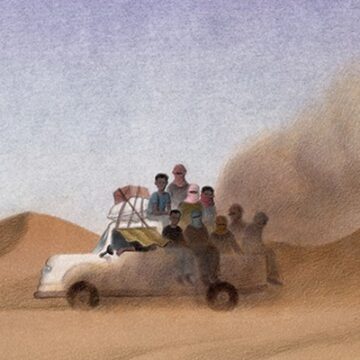
llustration by Daniele Castellano, suggestion of scene depicted:YAIM
Abstract: Backway to Europe is a podcast series produced in collaboration with Gambian advocates and activists. It centers their analyses of the border regime through their direct experiences of “the backway” — the local term for the illegalized route to Europe. These experiences resonate with many who have attempted to reach Europe across West Africa and beyond. Episode 1 begins where the story itself begins: with the hyper-restrictive European visa system for Gambian nationals that renders the backway the only viable option for many. It explains why obtaining a visa is almost impossible and sets the stage for later episodes, which show how European influence on Gambian national politics operates through global and historically layered inequalities that perpetuate neocolonial dynamics. The second episode explores the material and symbolic motivations for Gambian youth choosing the backway to Europe, contrasting the modern, individualized pressure to provide for family through remittances with the more communal and respected social status of “semesters” (emigrants) from previous generations. The third episode discusses how YAIM members retrace their perilous backway journey towards Europe in 2016/2017, across West African borders into Libya, highlighting the systemic violence, corruption, and gendered abuse inherent in these routes. In this fourth episode, we will discuss what happened once they were transferred to the detention center of Tariq al Sika and how it COULD BE connected to what was going on regarding the agreements between Libya, Italy and the EU. Episode 5 shows returnees’ solidarity and their struggle with broken promises and limited reintegration support. The sixth episode talks about migration from The Gambia is driven by structural inequalities rooted in colonial and neocolonial systems, not just individual choice. In the final episode, advocacy in The Gambia is critically examined as constrained by donor agendas, short-term funding, and structural inequalities, questioning its effectiveness while highlighting the human cost of deportations—especially from Germany.