

Adam Raz, 2024. Loot: How Israel Stole Palestinian Property. New York: Verso.
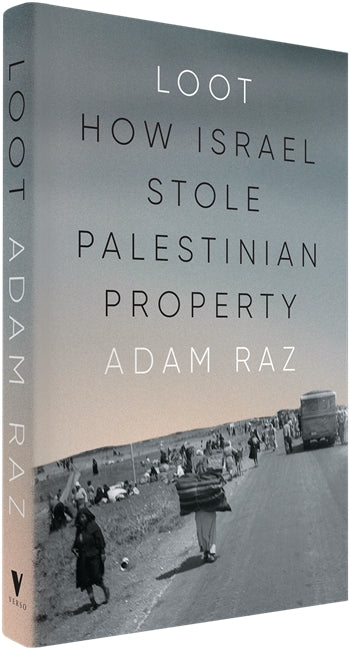
Adam Raz’s Loot: How Israel Stole Palestinian Property is a harrowing and meticulously researched histographic account of the widespread looting of Arab movable properties that accompanied the establishment of the State of Israel in 1948. Originally published in Hebrew and later translated into English, the book goes through a plethora of archival documents showing that, during the chaos of the Nakba (‘catastrophe’), when over 700,000 Palestinians of Arab descent were forcefully displaced or induced to flee, their homes, lands, shops, and personal possessions, which had no military value, were systematically and illegally looted by private individuals, military personnel, and state institutions. Raz unveils how this widespread theft was not episodic or merely incidental to the war, but was part of an intentional policy that became an integral factor of the state-building process.
His work, which relies on Israeli sources and internal documents, courageously unpacks what has long been marginalised in mainstream Israeli historiography, confronting uncomfortable truths that many Israelis would rather avoid. As such, it contributes to shedding light on an overlooked aspect of the complex origins of the Arab-Israeli conflict (cf. Kattan 2009).
The book is divided into two parts. The first part delves into the events of the looting that occurred in 1948, focusing on the actions of soldiers, civilians, and state actors who directly participated in the theft of Palestinian property amid war-related evacuations. Often, the number of non-Jewish residents permitted in the cities was strictly limited, and even the few Palestinian Arabs who remained were relocated and concentrated in barbered ghettos within the cities, which they could only leave with a work permit. Raz shows that looting of vacated Arab properties was widespread and systemic, ranging from individual soldiers and civilians breaking into abandoned homes to organised efforts to seize valuable assets. He examines individual cities (Tiberias, Haifa, Jerusalem, Jaffa, Acre, Safed, Beisan, Ramle and Lydda, and Beersheba) as well as smaller Palestinian villages, and also dedicates some pages to the fate of Mosques, Churches, and other places of worship. In some cases, such as in Jerusalem, the looting eventually got out of hand and turned to Jewish properties as well, besides having a general criminogenic effect which increased insecurity.
Raz paints a picture of a society that, in the midst of a foundational moment, lost its ethical compass, stealing the property not of abstract enemies, but of neighbouring inhabitants with whom they had often enjoyed peaceful and friendly relations.
The second part of the book shifts its focus from the facts of 1948 to their societal and moral implications, exploring how Israeli society failed to deal with its complicity in the looting during and in the aftermath of the events. He examines how the subject was repressed in collective memory, often buried under nationalist narratives, or framed as a military necessity or as an unfortunate but isolated aberration. The lack of a decisive judicial response to the crimes further contributed to the erosion of the collective sense of reprehension, which was later exacerbated by the Provisional National Council’s General Amnesty Order of 10 February 1949, granting general immunity for crimes committed during the war by civilians and members of the Israeli Defence Forces.
Many themes emerge from the book, making it more than just a historical account of theft. One of the most striking themes is the sociological phenomenon of the ‘collective psychosis’ (p. 209) of stealing, and the ‘bond of silence’ (p. 213) around it. This also points to the way in which war can erode moral boundaries. Raz paints a picture of a society that, in the midst of a foundational moment, lost its ethical compass, stealing the property not of abstract enemies, but of neighbouring inhabitants with whom they had often enjoyed peaceful and friendly relations. He reflects on the sense of shame and loss of moral rigour that undermined the value-based self-image of the Zionist pioneers. This would have lasting consequences on the new generations and their education and would become a permanent factor fanning the flames of hatred in the relations between the two people, the Jews and the Arabs (p. 305).
Ordinary civilians, new immigrants, and even Holocaust survivors who had experienced the same crimes as victims in Europe – all became participants in the normalisation of plunder and appropriation in Palestine. In this context, the boundaries between civilian and military actors became blurred. Raz shows how looting was not the isolated work of rogue soldiers or opportunistic civilians; it was often done in tandem. Soldiers broke into homes, took what they wanted, and sometimes returned with family members, neighbours, and even children to collect more. These acts were often carried out with the acquiescence of British authorities, and in some cases, such as Jaffa, even British troops participated in the looting. At the same time, civilians roamed freely through abandoned Palestinian Arab neighbourhoods and, in some cases, even in houses that were still occupied, hauling out carpets, furniture, pianos, books, clothing – the intimacy of the home irremediably violated. Army trucks were used daily to transport tonnes of stolen goods, and military officials coordinated the redistribution of property – property that was not necessary for war and could not be legitimately expropriated. Jewish families forcefully settled in vacated houses to establish a fait accompli, just as Israeli Zionists continue to do in the West Bank.
As Raz shows, the line between organised looting and spontaneous theft collapsed in the face of widespread impunity, lawlessness, and the unwillingness of most government and military authorities to intervene. While some municipal officials and cabinet members expressed dismay at the scale of the looting, including Prime Minister to-be Golda Meir, their efforts to restore order were largely unsuccessful, either because they were weak and inadequate, or because they were ignored and even actively undermined. Raz documents numerous instances where officials begged Israel’s leader David Ben-Gurion and other high-level government officials for intervention, only to be dismissed or sidelined. This breakdown of authority points to a deeper internal rift within the Zionist movement at the time and to another underlying theme of the book, i.e. the question around the moral foundation of the creation of the State of Israel.
Among all these important aspects, two themes are of utmost interest to me: first, the clear indictment of Ben-Gurion, and second, the way looting functioned as part of a broader policy of demographic engineering. Raz does not present Ben-Gurion as a distant or unaware leader caught off guard by the chaos of war and events on the ground. On the contrary, the archival evidence suggests that Ben-Gurion was fully informed of the scale and intensity of the looting and chose to tolerate it. He repeatedly ignored calls for intervention and concrete proposals from some political leaders and municipal figures who pleaded with him to stop the breakdown in civil order and warned of the social and political consequences of such lawlessness. Raz shows that Ben-Gurion’s ‘active’ negligence created irreversible facts on the ground that paved the way for the permanent removal of Arabs from the emerging State of Israel: their homes were emptied, villages were stripped bare, and any possibility of return was further obstructed by the destruction of material life, including orchards, wells, and waterlines. In Ben-Gurion’s intentional inaction, Raz identifies the existence of a deliberate policy to demographically change (or, as some would say, ‘ethnically cleanse’) the newly appropriated lands.
Palestinian refugees who might have returned after the war were deterred by the fact that there was no longer anything to return to.
This connects to the second theme that strikes me as reviewer: that looting was not just opportunistic theft, but – as I have written about previously (Pelliconi 2025) – a tool of demographic engineering to artificially create a Jewish majority in the nascent state. Amid the predominance of Arabs in the lands assigned by the Partition Plan to the emerging State of Israel, Zionist discourse at the time emphasised the urgency of securing a Jewish demographic majority for the Jewish state. The looting of homes, businesses, and personal belongings was part of a larger strategy of population transfer. Palestinian refugees who might have returned after the war were deterred by the fact that there was no longer anything to return to. Those who remained were subjected to daily humiliations, theft, and in many cases, violence, including rape, beatings, and arbitrary killings, which induced most of them to leave their homes and become displaced. The looting was therefore not a random by-product of war but one part of a broader strategy of displacement and ethnic substitution. Collective plunder forcibly turned looters who acted as individuals into ‘involuntary supporters of [Ben-Gurion’s] specific political policy’ that strove to remove Arab inhabitants from the State of Israel (p. 317).
This demographic engineering effort was later consolidated by the legal infrastructure of the new State of Israel, extensively analysed by Ardi Imseis in his recent book (Imseis 2023). The Absentees’ Property Law and the Citizenship Law of 1952 formalised dispossession, effectively barred return, and erased the legal identity of hundreds of thousands of Palestinians. The 1950 Law on Return granted Jews, people with one or more Jewish grandparent, and their spouses the right to relocate to Israel and automatically acquire Israeli citizenship, creating a dual system of inclusion and exclusion based on race and religion which some critical scholars such as Mazen Masri define as ‘exclusionary constitutionalism’ (Masri 2017). According to Raz, the plunder thus played a political role in the early years of the state: by emptying Palestinian homes and redistributing goods to Jewish settlers, it both normalised displacement and made the return of Palestinian refugees materially impossible. The looting was woven into the fabric of state-building.
Loot offers an implicit yet compelling account of what are considered violations of international humanitarian norms. Under the Hague Regulations of 1907 and their annex and the Fourth Geneva Convention of 1949, both of which codify long-standing customary law which applies to pre-existing armed conflicts, the pillaging of civilian property during war is strictly prohibited. Under the Rome Statute of the International Criminal Court, pillage constitutes a war crime. The same goes for the unnecessary and permanent forcible transfer of civilians, as well as the implantation of settlers in territories that are classified as occupied. The denial of the right to return could also constitute a crime against humanity. While Raz does not explicitly frame his historical analysis in terms of international law, the material he presents provides a strong foundation for understanding the gravity and legal implications of the events he describes. The mass looting of civilian homes and properties, coordinated or condoned by state institutions, indicates the existence of a policy or plan that was both widespread and systematic and would likely meet the threshold for prosecutable acts under modern international criminal standards. The book thus raises urgent questions about accountability, memory, and the enduring failure to address the legal claims of the Palestinian people. Such questions, that are subject to more extensive analysis in the work of legal scholars (e.g., Erakat 2019; Hammouri 2024), encompass issues of restitution, compensation, and recognition of Palestinian rights under international law, including the full exercise of self-determination as a praxis of decolonisation.
As the worst international crimes unfold in real time before our eyes, Loot helps us understand the ideological and structural continuity between past and present.
Of course, Palestinians today are facing much more urgent and catastrophic threats than colonial crimes from 1948. Yet it is clear that the current situation did not happen in a vacuum, but rather, it is a continuation of pre-existing structures. History continues to repeat itself – not because it must, but because humanity refuses to learn. As the worst international crimes unfold in real time before our eyes, Loot helps us understand the ideological and structural continuity between past and present. The foundational logic of demographic manipulation and dispossession has laid the groundwork for the ongoing reality of occupation, apartheid, and genocide against Palestinians today. The same mechanisms have continued and escalated in more systematised forms.
In the West Bank, out-of-hand land confiscations, large-scale settlement expansion, relentless home demolitions, and unrestrained settler violence reflect a clear continuation of the policies initiated in 1948, aimed at consolidating Jewish control over the territory while fragmenting and displacing Palestinian communities. The objective is to make the possibility of a State of Palestine unviable and to establish de facto Israeli ‘sovereignty’ over Palestine’s lands. The impunity and ideological framework that enabled the looting in 1948 have evolved into a fully-fledged regime of domination and segregation, with international law repeatedly violated and a population subjected to permanent insecurity and statelessness. Israel’s recent genocidal assault on Gaza, alongside open discussions about permanent annexation and mass expulsion, are a direct extension of the eliminationist logic of settler-colonialism (cf. Wolfe 1999).What began as looting and annexationist demographic engineering has hardened into an expansionist system of structural violence that continues to deprive Palestinians of land, rights, and life itself.
Although Loot does not centre the voices of Palestinian victims or survivors, which could be viewed as a limitation of the book, its strength lies in its rigorous use of archival and documentary sources from within Israeli institutions. This internal perspective is particularly valuable, as it exposes the extent of Israeli societal and political complicity using the state’s own records and testimony. While not a substitute for Palestinian narratives, Raz’s approach offers a powerful contribution to the historical record, especially in contexts where arguments grounded in Israeli sources may carry greater weight among Israeli and Western audiences. In this way, Loot not only documents the facts of looting and displacement, but also challenges dominant narratives from within, making it a compelling and strategically important intervention.
Featured Image: Broken clear glass panel. Source: PickPik.
References
Noura Erakat, Justice for Some. Law and the Question of Palestine (Stanford University Press 2019)
Shahd Hammouri, ‘The Palestinian Right of Self-determination as Decolonisation’ (2024) Global Community: Yearbook of International Law and Jurisprudence
Ardi Imseis, The United Nations and the Question of Palestine: Rule by Law and the Structure of International Legal Subalternity (Cambridge University Press 2023)
Victor Kattan, From Coexistence to Conquest: International Law and the Origins of the Arab-Israeli Conflict, 1891–1949 (Pluto Press 2009)
Mazen Masri, The Dynamics of Exclusionary Constitutionalism: Israel as a Jewish and Democratic State (Hart Publishing 2017)
Andrea Maria Pelliconi, ‘The Demographic Battle for Palestine in the Settler-Colonial Project and the Promise and Peril of International Law’ (2025) Journal of International Humanitarian Legal Studies.
Patrick Wolfe, Settler Colonialism (Bloomsbury Publishing 1999)