In memory of Akiko Sugase (1971-2025)
From March 13 to June 17, 2025, a Thematic Exhibition for the 50th Anniversary of the Museum’s Founding, Lines and Dots: The Aesthetic Journey of Arabic Calligraphy was held at the National Museum of Ethnology in Osaka, Japan. Together with the late Akiko Sugase, we, three social anthropologists of the Arab world were the main curators of this exhibition. The exhibition had four chapters: 1. Ḥarf [letter]: The World of Arabic Letters, 2. Kitāba [handwriting]: The Golden Age of Calligraphers, 3. Khaṭṭ [calligraphy]: Modern Engagement with the Classics, and 4. Fann [art]: Contemporary Calligraphy. Since the majority of our visitors have no knowledge of Arabic script, it was crucial to equip them with the basics of Arabic writing as well as the historic and geographic spread of Arabic script in Chapter 1. Chapter 2 shows the renewed demand for calligraphy in the twentieth century. Publishers and TV stations hired the best calligraphers of the time. They were also commissioned to write street name signs and shop boards. Chapter 3 and 4 exhibit calligraphy as fine art to illustrate how calligraphers position themselves in relation to global art discourses.
Although calligraphy is close to the heart of many people in Japan, our exhibition is the first one to bring Arabic calligraphy to the centre stage. We have situated Arabic calligraphy in global history. The introduction of various technologies and mass media since the early twentieth century had transformed the role of calligraphers not only in the Arab world but also in Japan. Digitisation of communication is taking place everywhere. By contextualising the social roles of Arabic calligraphy in media history, we have attempted to challenge our audiences’ penchant for essentialising unfamiliar culture as something exotic.
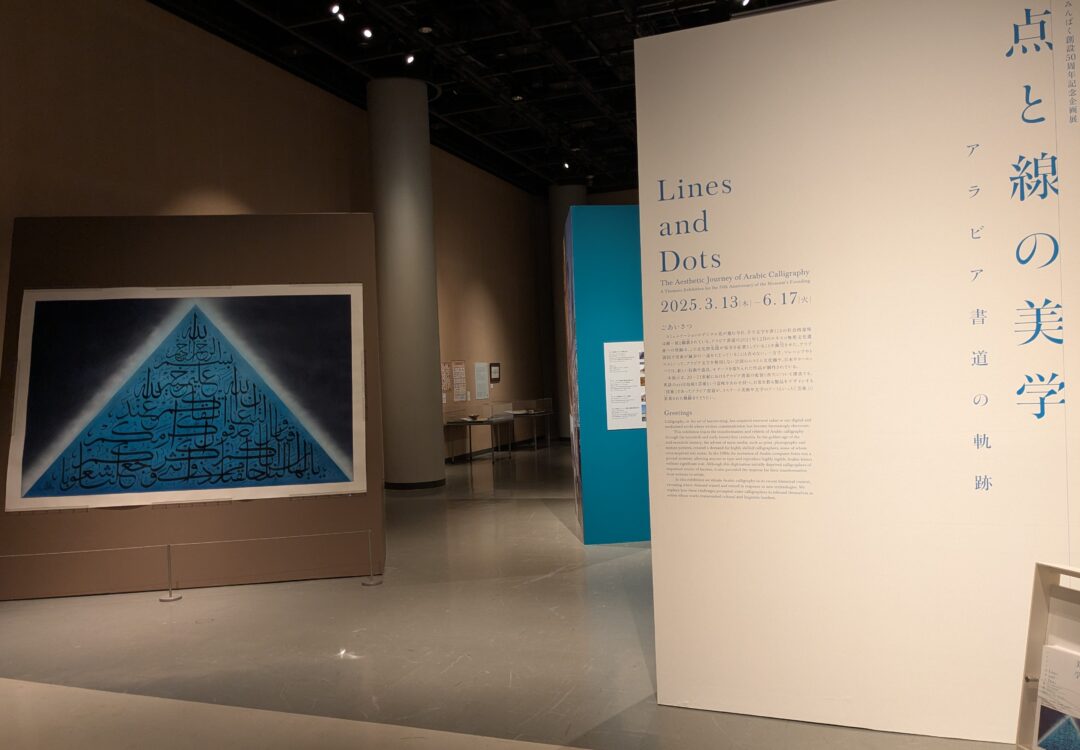
Fuad Kouichi Honda’s Pyramid of the Mankind displayed at the entrance of the exhibition. Photo by Hatsuki Aishima, 2025.
Arabic Calligraphy as a Field of Contention
What might or might not constitute an authentic, beautiful piece of calligraphy is in the eye of the beholder. Our aesthetics are honed and acquired through social experiences. The aesthetics of Arabic calligraphy which appear almost “natural” and “universal” to those who are familiar with this artistic tradition might not communicate so well to those who have never been exposed to it.
The introduction of various technologies and mass media since the early twentieth century had transformed the role of calligraphers not only in the Arab world but also in Japan.
To convey the aesthetics of Arabic calligraphy, the exhibition has to give a faithful account of the normative perspectives of professional calligraphers on their art. They are the people with whom we worked in close collaboration during all steps of the exhibition. On the other hand, the exhibition illustrates that there is no unitary vision of whom is legitimate to speak about calligraphy, of its aesthetics and of its rightful uses. Aymon, for example, witnessed multiple times during fieldwork the lively debates among calligraphers concerning the definition of authentic Arabic calligraphy. As such, there are items displayed in the exhibition which not all calligraphers would approve of.

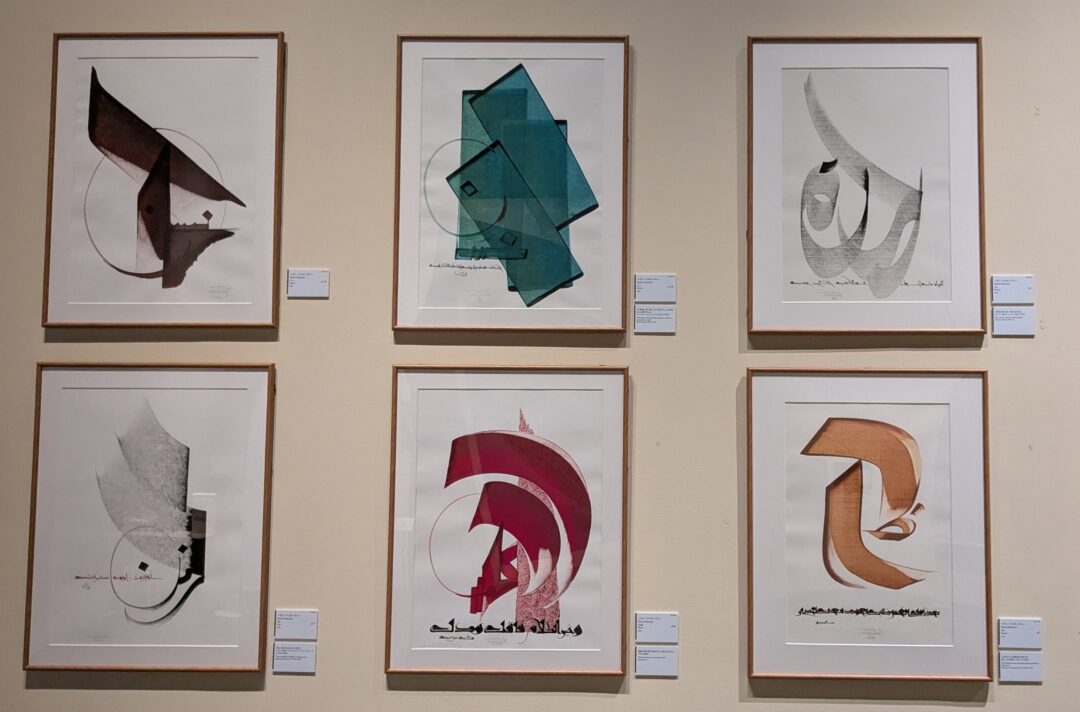
Artworks from Chapter 3 Khatt which adhere to the classics of calligraphic styles. Photo by Hatsuki Aishima.
For instance, our exhibition included reproductions of calligraphy for decorating vehicles, although we were aware that professional calligraphers would find them poorly executed. Likewise, they might view offensive the photographs of scantily clad actress on the Egyptian vintage film pamphlets in the exhibition because Arabic calligraphy evolved as an art of writing down Quranic verses. In the chapter Khaṭṭ, the exhibition includes the works of famous calligraphers who strictly follow the classical rules of the art, such as Salah Abd El-Khalek, Ahmed Fahd, and Abduh Elgamal. In the chapter Fann, the exhibition shows pieces from artists who broke with these rules, such as Hassan Massoudy and Izabela Uchman.
Our aesthetics are honed and acquired through social experiences.
We planned the exhibition structure in a way to expose our visitors to these conflicting perspectives on calligraphy. How to deal with the challenge of having to work in close collaboration with calligraphers without privileging one perspective over another? The key, in our perspective, is to approach the museum as a forum, rather than a temple. Thatis is, to consider all contributors to the exhibition as those individuals who have different strategies for communicating a truthful understanding of calligraphy. The exhibition is not a finished product, as in a printed book, but an ongoing process that initiates various conversations about what may or may not constitute the aesthetics of Arabic calligraphy.
Cultural Transmission as an Exercise of Reckoning
In his study of the colonial history of Madagascar, Takumi Moriyama (2013) urges us to pay close attention to the changing meaning of artefacts depending on who mobilizes them as cultural resources for which audiences, and with which expectation about their reception. This, we will argue, allows us to conceive the exhibition as a metalevel dialogue with the calligraphers about the means of cultural transmission.
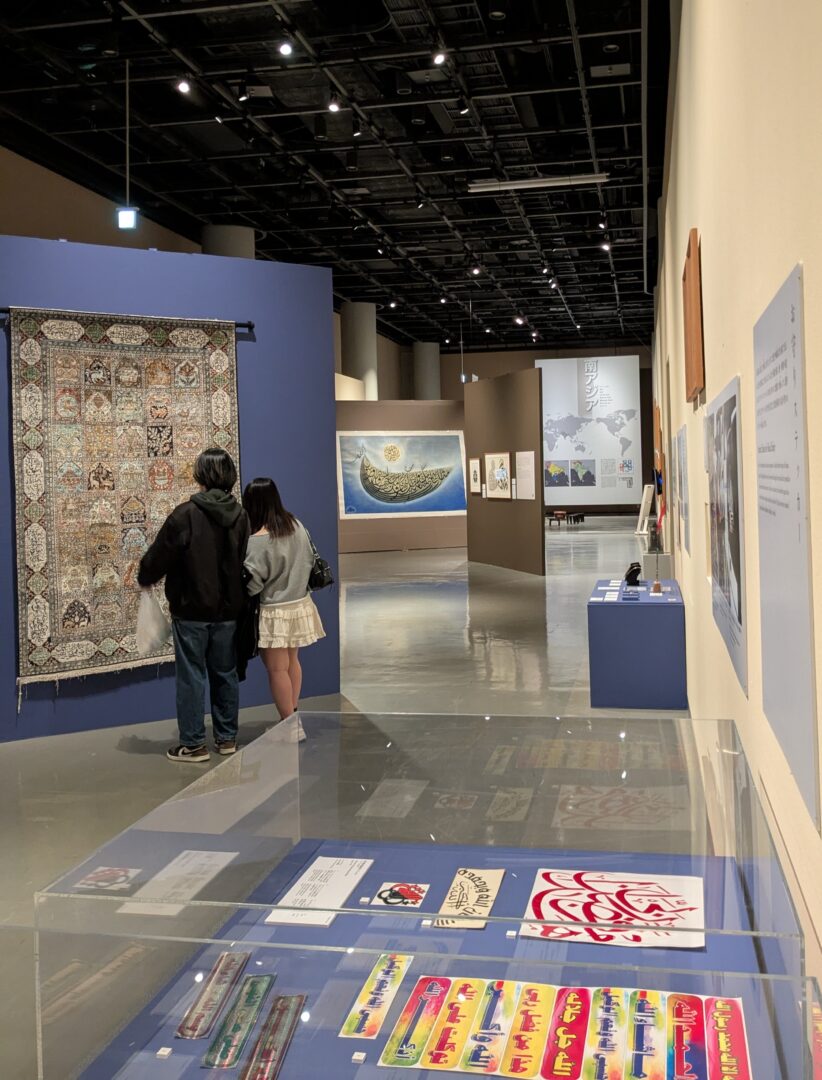
Calligraphy design stickers for decorating vehicles (bottom right). Photo by Hatsuki Aishima, 2025.
In Egypt, calligraphers upholding classical approaches to Arabic calligraphy complain that the younger generation has no clue of the proportion rule central to its aesthetics, due to digitalization, the low level of public education, and neglect by the government. Their assessment rests on a general assessment of how Egyptians understand calligraphy. They refer to Islamic spirituality, cultural heritage, and the harmony of proportions to convince people of the importance of their art.
The key, in our perspective, is to approach the museum as a forum, rather than a temple.
Calligraphers living in countries where most of the audience do not speak Arabic, as Hassan Massoudy in France or Fuad Kouichi Honda in Japan, attempt to find an aesthetic language in calligraphy which resonates with the people there. Massoudy combines abstraction with poetry to reach out to his audiences, whereas Honda defines Arabic calligraphy as “music without sound”. Similar to opera in which the audience can appreciate La Traviata without understanding Italian, Arabic calligraphy has the power to captivate its viewers regardless of their knowledge of Arabic script. Both Massoudy and Honda challenge what we conceive of the divide between writing and drawing. There is no doubt that they are writing, rather than drawing, yet the letters and images are in unison in their calligraphy.
The exhibition illustrated these multiple efforts of cultural transmission. Calligraphers present their works to audiences unfamiliar with their art, either because the knowledge about calligraphy has been lost to younger generations, as in Egypt, or because they work with audiences outside the Middle East. By doing so, these artists make sense of what could interest people and move them, as we do when we try to understand what the Japanese visitors of the exhibition would have to learn to appreciate Arabic calligraphy.
Calligraphers living in countries where most of the audience do not speak Arabic, as Hassan Massoudy in France or Fuad Kouichi Honda in Japan, attempt to find an aesthetic language in calligraphy which resonates with the people there.
Despite the differences in methodology between calligraphers and anthropologists when speaking about society, we share similar challenges. Calligraphers struggle to grasp their audiences’ understanding as much as anthropologists in preparation of an exhibition do. Presenting the multiple roles of calligraphy requires an exercise of reckoning the aesthetic sensibilities of those we hope to reach out. Acknowledging the limitations of such exercise makes it paradoxically easier to envision it as a common endeavour. Such awareness is crucial when putting into practise the principles of museum as a forum. In the age of digital media, calligraphers do not need a museum or anthropologists “representing” their perspectives. They can speak for themselves. Museums have assumed a new role to serve as the venue for facilitating the conversations between anthropologists and the people they meet in the field.
References
Moriyama, T. 2013. Cultural Resource in Action: Mobilization of Culture in Madagascar under French Colonial Rule. Japanese Review of Cultural Anthropology 14, 31-53.