
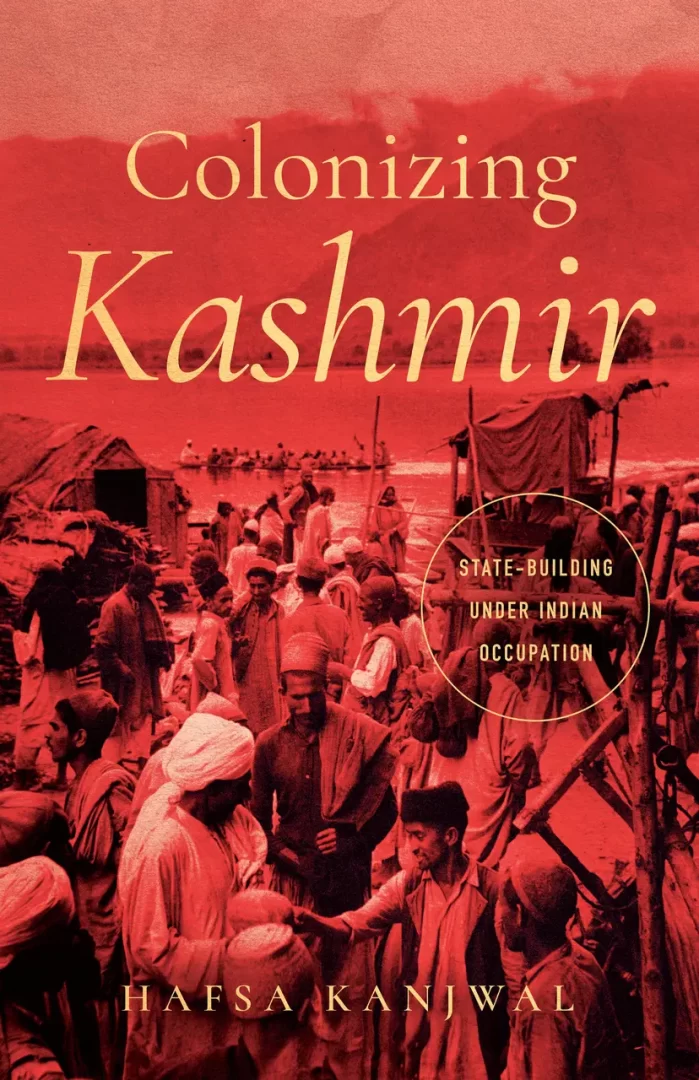
Hafsa Kanjwal. 2023. Colonizing Kashmir: State-Building Under Indian Occupation. Stanford: Stanford University Press.
Decolonization across the so-called Global South led to the independence of many countries. The Indian subcontinent, previously ruled by the British, was divided into Hindu-majority India and Muslim-majority Pakistan in 1947. In this division, also called the partition, many national and subnational entities were either forced to join one of the dominions or were linked by situational necessity. The princely State of Jammu and Kashmir, which was ruled by the Dogra dynasty of Jammu, was a Muslim-majority region but was ruled by a Hindu king. The regions of Jammu and Kashmir had come to be formed as a single unit after the British sold the entire Kashmir valley to the Maharaja Gulab Singh by the Treaty of Amritsar in 1846 for a certain sum of rupees and annual gifts offered to the British rulers. The treaty ushered in a new phase of contestation in the history of Kashmir, as the Dogra rule was characterized by increased repression of the Muslim subjects.
The treaty ushered in a new phase of contestation in the history of Kashmir, as the Dogra rule was characterized by increased repression of the Muslim subjects.
Amid the retreat of British colonial power from India, the princes of the more than five hundred princely states were given the choice to join India or Pakistan, or to stay independent. Maharaja Hari Singh, the last ruler of the princely state, was hesitant to surrender monarchical control and thus wanted to remain independent. The Muslim majority composition further complicated the issue as he faced rebellion across the state. He had therefore lost control over the territories he was ruling. Before the contested accession of the state to India took place, a few notable events, including the 1947 war fought over Kashmir between India and Pakistan following the targeted killings of thousands of Muslims in Jammu by the Dogra forces, and the Poonch rebellion. All these events led to political uncertainty in the state. To annexe the territory of Jammu and Kashmir, India’s first Prime Minister, Pandit Jawaharlal Nehru, secured the accession of the state by its last king after promising a “reference to the people”. The contested accession and Nehru’s unfulfilled promise of reference led to the creation of a substate entity in Kashmir, headed by the local Kashmiri Muslim elite who were often brought to power by rigged elections.
It is this state-making in conflict-ridden settings that Hafsa Kanjwal examines in her award-winning book Colonizing Kashmir: State-Building Under Indian Occupation. Kanjwal’s work is groundbreaking and relies extensively on primary materials such as archives, interviews, letters, memoirs, propaganda materials, and other critical sources.
Colonizing Kashmir critically intervenes in dominant narratives that have long framed Jammu and Kashmir through the narrow lens of bilateral conflict and security discourse. This mainstream epistemology often marginalizes the region’s internal complexities, historical textures, and lived realities. By centering Kashmir’s histories and interrogating the “coloniality of knowledge” that privileges statist, nation-centric paradigms, Kanjwal’s work could be positioned within the growing field of critical Kashmir studies. Her scholarship not only recentres the Kashmiri subject but also reveals how postcolonial states like India have themselves initiated “colonial” projects, thereby displacing colonialism as merely a Western prerogative. Kanjwal foregrounds the pivotal role of G.M. Bakshi, installed as the second Prime Minister of Jammu and Kashmir by the Indian state following Sheikh Abdullah’s dismissal in 1953, in advancing India’s project of political integration.
Kanjwal studies the modes of state control used by the Indian government, the institutions they subsequently gave rise to, and the nature of the state and the sub-state entities in Kashmir.
Kanjwal uses Neve Gordon’s phrase “politics of life” to describe the process “in which the Indian government and Kashmir’s client regimes propagated development, empowerment, and progress to secure the well-being of Kashmir’s population and to normalize the occupation for multiple audiences” (9). The techniques of biopolitical governance, such as welfare, development, and fulfilment of daily needs, were meant to suppress political demands such as the plebiscite or the right to self-determination and based in the assumption that Kashmiris did not possess any political aspirations. India’s first Prime Minister, Pandit Jawaharlal Nehru’s letter to Sheikh Abdullah in 1952 demonstrates this key notion. He wrote to Abdullah: Kashmiris “…are soft and addicted to easy living. […] The common people are primarily interested in a few things—an honest administration and cheap and adequate food. If they get this, then they are more or less content” (1). Kanjwal studies the modes of state control used by the Indian government, the institutions they subsequently gave rise to, and the nature of the state and the sub-state entities in Kashmir.
In her opening chapter, Kanjwal briefly discusses the Dogra period and the political mobilizations in that period. Bakshi’s rule post-1953 was inspired by Naya Kashmir, a socialist document formed under the leadership of the National Conference (NC) supremo Sheikh Abdullah that shaped the politics of Kashmir after the arrest of Abdullah by Nehru. Irrespective of his support for the idea of autonomy for Jammu and Kashmir within the Indian jurisdiction, Sheikh Abdullah’s dismissal was brought about, and Bakshi Ghulam Mohammad, a member of Sheikh’s NC, was installed as the Prime Minister in his place. The coup marked a turning point in Kashmir’s history. To reshape India’s policies in Kashmir, facilitate “integration”, and avoid international pressures, Bakshi built on the “politics of life” to bring material and infrastructural development to Kashmir while also promoting the narrative of democratic governance.
In Chapter 2, Kanjwal explores how Bakshi’s government deployed media and propaganda to simulate normalcy amid political uncertainty. This state-sponsored portrayal echoes present-day practices, particularly the J&K Media Policy 2020, which censors dissent and distributes government advertisements to compliant news agencies. As Kanjwal notes, the Bakshi administration invited international journalists and ambassadors to Kashmir to legitimize India’s territorial claims, tactics that saw a repetition after the abrogation of Article 370 in 2019. Similarly, Bakshi emphasized the economic benefits of integration while deflecting questions of self-determination, a rhetorical strategy now reiterated by the Modi government’s promise of a “new Kashmir”, post-2019.
Indian cinema, as Kanjwal shows, sustains this ideological project by erasing Kashmir’s history and politicization, often reducing Kashmiri resistance to “terrorism”, thereby justifying India’s role as a saviour state.
In Chapter 3, Kanjwal explores how Indian cinema has reproduced colonial desires and nationalist claims over Kashmir. Represented historically as a “paradise”, the region has long been seen as a “territory of desire”, from Mughal conquests to British depictions of it as the “Switzerland of the East”. Indian cinema, as Kanjwal shows, sustains this ideological project by erasing Kashmir’s history and politicization, often reducing Kashmiri resistance to “terrorism”, thereby justifying India’s role as a saviour state. For instance, Kashmiris fighting for their rights have always been stereotyped as “terrorists” in Bollywood movies, only to be rescued by an Indian hero. This cinematic narrative aligns with Nehru’s 1952 statement to Sheikh Abdullah, claiming that a close association with India could provide the security and stability Kashmiris needed (Noorani, A.G., 2014). Films such as The Kashmir Files (2022) and Article 370 (2024), produced after the abrogation of Article 370, exemplify how Indian cinema continues to demonize Kashmiri Muslims and whitewash decades of state oppression.
Chapter 4 traces how Bakshi surrendered Kashmir’s financial autonomy to gain economic aid and political legitimacy. In contrast to Sheikh Abdullah’s vision of economic self-reliance, epitomized in his advocacy for growing potatoes over importing subsidized food grains, Bakshi prioritized short-term gains. “Aloo Bab” (father of potatoes), as Abdullah came to be known, was dismissed under the guise of economic failure. Kanjwal critiques this notion of developmentalism, illustrating that it masked dependency on Indian subsidies under the banner of the Naya Kashmir manifesto of 1944. This structural dependency persists even today, and any disruption in food supply triggers panic buying in the region, highlighting how a culture of self-sufficiency has been eroded by fear and reliance.
In Chapter 5, Kanjwal analyzes the formation of the Kashmiri subjectivity under the postcolonial Indian state. Education was one of the least of the concerns of the Dogra state, and there was no infrastructure to educate the people. As Kanjwal illustrates, even when educational institutions came to be established during the Dogra period, they did not benefit the majority population of the state, but rather mostly the Kashmiri Pandit population. In 1941, less than a decade before the collapse of the Dogra state, only 1.6 per cent of Kashmiri Muslims were literate. Several findings, including the Sharps Report of 1916 and the Glancy Commission formed after the 1931 revolt, not only highlighted the systemic exclusion of the Kashmiri Muslims from state services, but also recommended the enhancement of education and state scholarships and the appointment of teachers from the Muslim community. Later, the Naya Kashmir manifesto, proposed by the National Conference in 1944, recommended a free and compulsory education system. It proposed scholarships in higher education and the establishment of technical institutions, with equal access to education for women.
Bakshi upheld the values enshrined in the Naya Kashmir manifesto, subsidizing higher education. The allocation of the budget for education was doubled in 1956, and there was a substantial increase in the overall expenditure on education. The educational transformation resulted in a revolution in public education in Kashmir, with increased student enrollment and employment opportunities in the teaching sector, mostly benefitting Kashmiri Muslims. Even as education became accessible to many people, it did not escape the “integrationist” politics of the Indian state functionaries. The educational reform aimed to create what Kanjwal calls the “modern Kashmiri subject”. According to Kanjwal, secularism was promoted to align the Kashmir Muslim subject with the broader Indian secular identity and history, thereby establishing a marked difference from Pakistan and paving the way for the normalization of the contested accession.
In Chapter 6, the author considers the institutionalization of Kashmiri culture in Bakshi’s state-building project. In 1956, Bakshi emphasized the importance of cultural heritage and how it would “provide means of greater contact and fraternization between the people of this place and those living in the rest of India” (203). Jashn-e-Kashmir, a spectacle of state-building, was a cultural festival aimed at legitimizing Bakshi’s rule, fostering emotional integration with India and projecting a picture of normalcy to the outside world. While the state appropriated the Kashmiri culture and there was a monopoly on defining what constituted Kashmiri culture, Kanjwal argues that maintaining such a monopoly was “intimately linked to the maintenance of India’s colonial occupation” (210). Kanjwal narrates the compelling case of the Kashmiri poet, Ghulam Nabi Khayal, to show how state patronage played a role in coercing intellectuals to align with state interests and depoliticize themselves and their work. Khayal had been arrested for supporting Sheikh Abdullah, and after spending two years in jail, Bakshi approached him and asked him to quit politics and think of his family. Khayal was offered a government job, some financial assistance and the publication of his translated work. The economic precarity of the artists was thus exploited to control the opposition to the Bakshi regime, and the co-optation of the Kashmiri intelligentsia, particularly artists, was made possible as most of the artists were living through precarious economic conditions.
By studying the state-building phase under Bakshi post-1953, often termed a peaceful period in academic and mainstream history, Kanjwal also challenges the notion that the conflict resulted from the insurgency that started after the election rigging of 1987.
Chapter 7 deepens the analysis by revealing how intelligence networks and surveillance shaped everyday life in Kashmir. Drawing from Amin Kamil’s story “The Shadow and the Substance,” Kanjwal shows how repressive mechanisms predate Bakshi and can be traced back to Sheikh Abdullah’s era. Through figures like the “Khuftan Faqirs” and “Goggas,” which we, as children, only knew as mythical or folkloric threats used by elders to discipline us, Kanjwal reveals their more profound political and historical significance. They were not merely products of imagination but were rooted in state surveillance and repression tactics. In recovering the origin of this phraseology, among other things, Kanjwal demonstrates how repression under the Indian and J&K governments became embedded in popular memory and everyday cultural expressions.
Kanjwal’s work exemplifies how postcolonial nations can attain imperialist tendencies and become colonizing entities. Bringing to the fore the popular memory of the Kashmiri people, which had hitherto not received enough attention, she introduces new ways of thinking about the broader Kashmir conflict and critical Kashmir studies in particular. By studying the state-building phase under Bakshi post-1953, often termed a peaceful period in academic and mainstream history, Kanjwal also challenges the notion that the conflict resulted from the insurgency that started after the election rigging of 1987.
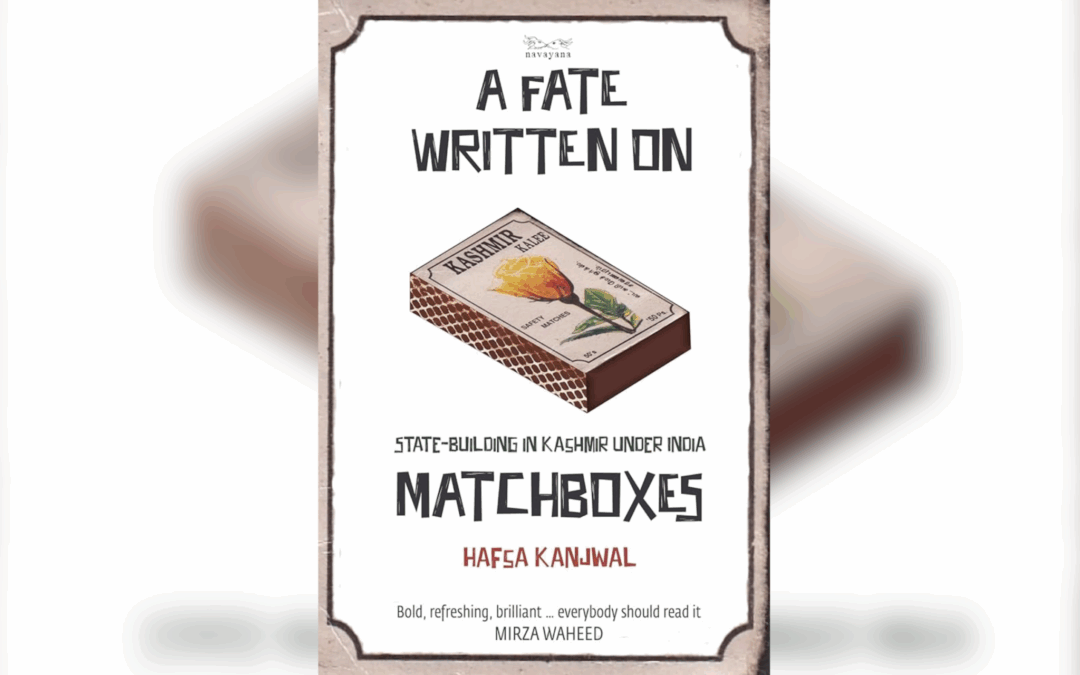
Featured Image: A Fate Written on Matchboxes. Source: Navayana.