

In memory of
Sabine Luning
(30 August 1959 – 6 March 2025)
whose support and input has shaped our thinking in crucial ways and whose death is a reminder that we do not have all the time in the world
They say here ‘all roads lead to Mishnory.’1 To be sure, if you turn your back on Mishnory and walk away from it, you are still on the Mishnory road. To oppose vulgarity is inevitably to be vulgar. You must go somewhere else; you must have another goal; then you walk a different road.
Ursula K. Le Guin (1969/2018), The Left Hand of Darkness, p. 151
It feels safe to say that our present social, political and ecological juncture requires many hands on deck. Similarly, it seems obvious to argue that this juncture calls us to attend to and nurture ways of living that depend less on the various forms of (industrial) extraction, and decentre the idea of ‘development’ as unidirectional, linear, financial and material growth. We – a collective of interdisciplinary scholars and artists – argue that such action requires understanding not only the extractive sector, its socio-ecological impacts and the lives it enables and disables, but also engaging with forms of research and education that aim to decolonise knowledge and foster possibilities for diverse past, present, and future worldings.
Decades of critical research and activism have revealed the highly uneven distribution of extractivism’s (economic) benefits and harms (Beckert et al. 2021; Behzadi et al. 2023; Green 2020; Hamouchene 2023; Winchell and Howe 2024), and that the search for alternatives so far has only challenged development models and practices, not altered or replaced them. Supposedly sustainable development trajectories, by reproducing conventional extractivist models and their implications, are increasingly recognised as a new wave of ‘green extractivism’ rather than a real alternative to it (Bruna 2022; Curley 2018). At the same time, extractivist projects like fossil fuel or industrial agricultural development continue to invoke promises of development and economic growth, and inspire hope in many.
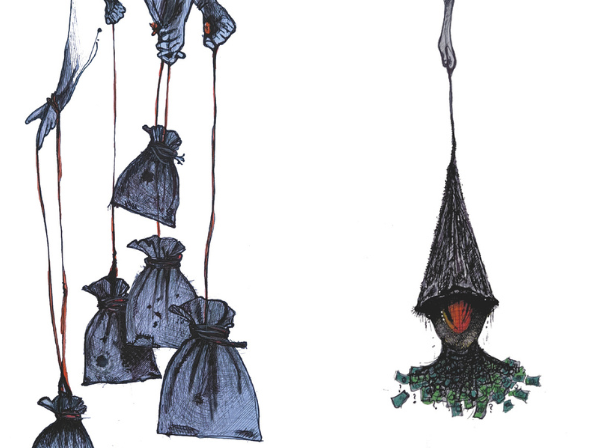
Left — Walter Zand, Born to Suffer; Right — Walter Zand, Who Profits
With this initiative and manifesto, ‘Alternatives to Extractivism’ (A2E),2 we explore how researchers can better attend to the diversity of ways of being, knowing and doing alongside the (sub)soil and other-than-humans more broadly. In what Chakrabarty (2021) might call ‘a planetary move’, the (sub)soil makes itself known to human and other-than-human beings on Earth through earthquakes, volcanic eruptions, tsunamis and other ‘natural’ disasters. If we don’t find more careful ways to navigate the planet’s reaction to growing human influence, it may become uninhabitable by life as we know it.
| A word on terminology: Other-than-human We mostly use the notion of other-than-human in this manifesto, and at times refer to living and non-living entities. We use ‘other-than-human’ (instead of, for example, non- or more-than-human) to accommodate a broad range of actors, including those that do not fit the boundaries of the bios. ‘Other-than-human’ includes not only plants and animals but also soils, minerals, mountains, glaciers, fire, technologies and data, as well as ancestors, spirits and ghosts (Price and Chao 2023). We also use ‘other-than-human’ to avoid invoking hierarchies of worth, manifested in the valuing of different species and humans, defining which lives are disposable and which grievable (ibid; Butler 2010; Vergès 2021). |
One might argue that by stating that we seek to decentre extractivism, we are actually doing the opposite: as Le Guin tells us, ‘You must go somewhere else; you must have another goal; then you walk a different road’. However, we posit that engaging with alternatives to extractivism means exploring and navigating the very tension inherent in (de)centring. With Akomolafe (2024), we hold that the new must include the old: there is no pure departure, no pristine new. We thus seek a diversity of encounters with the (sub)soil as a source of hope – not yet knowing what these encounters might be.
We hold that the new must include the old: there is no pure departure, no pristine new.
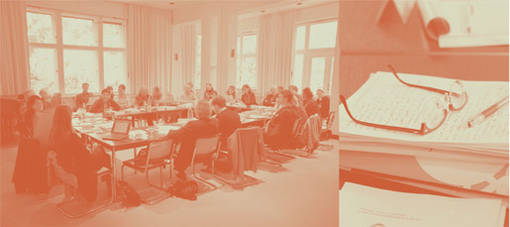
Our collective of academics, activists, and artists engaged with these issues during an A2E workshop3 in Maputo, Mozambique, where we explored a series of questions concerning research on this complex subject; artistic expressions and (conceptual, empirical) engagement with the issues raised shaping each other in turn. Affect featured in and shaped our discussions in multiple ways; not only due to affective dimensions evoked by extractivism and extractive projects, but also our shared investment in the issues discussed and the multisensorial engagement stimulated by different artworks.
We continued our conversations from this workshop in both in-person and online sessions of collaborative writing. The affective dimensions of our collaboration became even more apparent during this period, especially in the aftermath of Mozambique’s October 2024 elections. The week following the elections saw the assassination of two members of the opposition, Paulo Guambe and Elvino Dias. As we worked on the manifesto, there were nationwide controversies around the way the election and the publication of the results had taken place, and over 300 people lost their lives in the conflict (Plataforma Decide 2025). With situations such as these in mind, attending to other ways of being knowing and doing, let alone alternatives to extractivism, seemed only a weak intellectualised effort to find alternatives compared to the struggles of people on the ground. However, for us it further emphasised how topical the idea of alternatives remained.
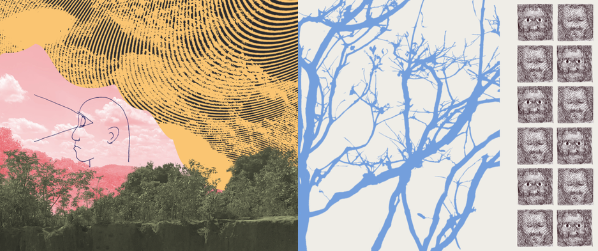
Zoë Viñas Crutcher, Perspective.4
This manifesto has drawn inspiration from various bodies of scholarship, forms of activism, and creative artistic interventions and expressions. We seek to bring together work on a) resources and their making, including their spatial and temporal dispersion and contestations (Ferry and Limbert 2008; Matusse 2018; Richardson and Weszkalnys. 2014; Weszkalnys 2023); b) alternatives and futures (Svampa 2019; Cork et al. 2023), c) decoloniality, epistemologies of the south, and the pluriverse (Mignolo 2007; De Sousa Santos and Meneses 2010; De la Cadena 2015; Escobar 2017; Ndlovu-Gatsheni,2021; Arora et al 2025), and d) subversive cosmopolitics (Bacigalupo et al. 2024). Additionally, we build on a growing body of social science scholarship that looks below the surface and examines (sub)soils, the subterranean, under- and belowground (e.g. Appel, Mason and Watts 2015; Lyons 2020; Salazar et al. 2020; Luning 2022; Granjou and Meulemans 2023), and place-based arts of dwelling (Kimmerer 2013; Watts 2013; Krzywosynska et al. 2020). Together, these literatures offer rich and compelling theoretical engagement with alternative imaginations and worldings across space and time. In different ways, they respond to traditions to not only study the world but contribute to worlding differently (hooks 1994; de la Cadena 2015; Ahmed 2017; Eshun 2022; Bacigalupo et al. 2024).
Caring about soil can thus make time differently, fostering a form of intimacy in which different temporalities can co-exist.
| Knowing and caring about soil What we believe soil to be affects the ways in which we care for it and vice versa, Maria Puig de la Bellacasa (2015: 692) observes. Soil can be understood in geological terms, for example. We could then draw distinctions between soil horizons and identify in/between which horizons particular forms of mining might take place. Drawing on soil science, ‘knowing’ soil can refer to understanding the chemical composition of topsoil and which forms of farming it may be conducive to. However, as Wiersma and Lopez (2024: 3) posit, rather than these detached modes of knowing, soil science requires ‘an intimate feeling for soil,’ a ‘mud love’ in Puig de la Bellacasa’s words (2019: 399). This intimacy goes deep; Krzywosynska and colleagues (2020) show that understanding and care for soils, including that used for agriculture, requires literal depth of knowledge (see also Wilson 2019). Our main point of departure is that both below and aboveground living worlds are characterised by a dynamic liveliness. We understand soil as a situated web of relations that ‘is everywhere yet nowhere the same’ (Wiersma and Lopez 2024: 3). Central too is the understanding that soil’s liveliness occurs on widely differing timescales: ranging from the aeons involved in soil formation to the one-day life cycles of certain fungal spores (Salazar et al. 2020). MacFarlane (2019) notes that when viewed in deep time, that which seems inert comes alive. Taking the example of limestone, he sums up its deep time life cycle as: ‘mineral becomes animal becomes rock; rock that will in time – in deep time – eventually supply the calcium carbonate out of which new organisms will build their bodies’ (p. 32). Soil is deeply evocative of what Haraway names Chthonic Ones; an Earthbeing ‘both ancient and up-to-the-minute’ (Haraway 2016: 2). In light of the widely varying life cycles of below and above ground worlds, Puig de la Bellacasa (2015: 709) calls for making time for soil time. This making of time is not about slowing down or aligning diverse timelines, but instead about ‘rearrang[ing] and rebalanc[ing] relations between a diversity of coexisting temporalities’ across different ecologies (ibid.). Caring about soil can thus make time differently, fostering a form of intimacy in which different temporalities can co-exist (Schrader 2015). |
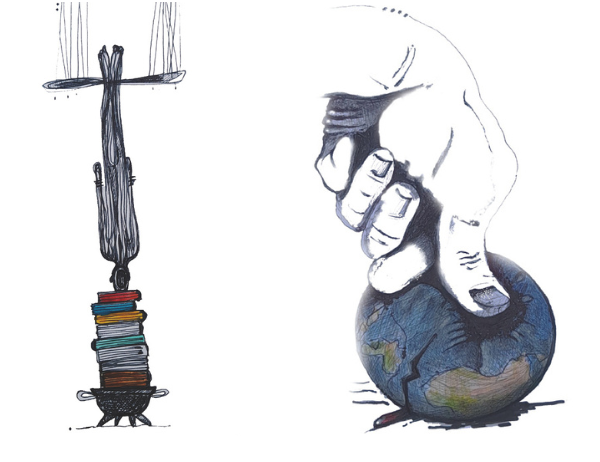
Left — Walter Zand, Tradition, Modernity, The Power of Knowledge; Right — Walter Zand, Slow Violence
We have tried to create and participate in a different kind of academia. Although this manifesto is embedded in existing scholarship, it is neither a comprehensive ‘state of the art’ review of these literatures, nor does it claim to break new ground. Although the word ‘manifesto’ suggests fully articulated ideas and certainty, we do not necessarily claim that either. Rather than answering questions and taking a unified position, we pose (and close the manifesto with) questions to hint at ways of thinking-feeling about collaborative methodologies that more broadly attend to diverse ways of being, knowing and doing with the (sub)soil and other-than-humans. As such, this manifesto is composed not of theses, but of propositions (Baptista and Cirolia 2022; Akomolafe 2024). The first two propositions bring together conceptual work on epistemic considerations and on space and time, the third and central one is a modest attempt to explore what extractivism and its alternatives might be, and the fourth and fifth delve into the real-life and methodological struggles of seeking alternatives. Our words are accompanied by artwork created during the workshop and subsequently, a series of collages which use sketches made by Luís Santos during the workshop and photographs taken by an A2E team member in northern Mozambique. The artworks pose their own questions: they are not intended to illustrate the text but to show our starting point from the perspective of engaged artists in Mozambique and beyond.
1. Relationality and Co-constitution: Performing Onto-epistemic Politics
We need to explore the political implications and possibilities of healing when we ground our epistemic work in relational ontologies.
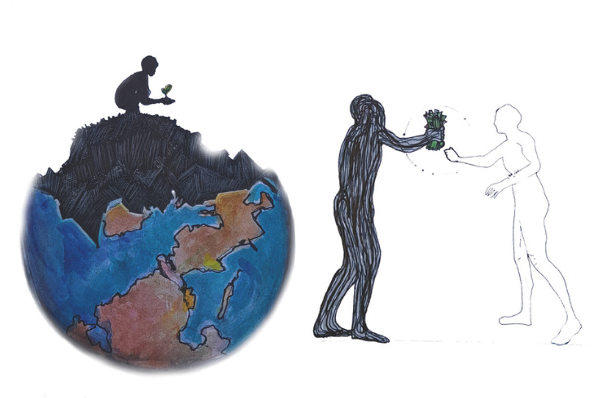
Left — Walter Zand, Green Recolonialism; Right — Walter Zand, Visibility Invisibility
Often, the places subjected to extraction and other forms of exploitation are also home to Indigenous communities that are marginalised or underprivileged within regional and national contexts. The environmental destruction inflicted on them threatens to damage the varied relationalities that hold together those landscapes’ human and other-than-human dimensions (de la Cadena 2015). Keeping in mind that relational ontologies are not singular or unified, we seek dialogue with diverse (not different: Braga et al. 2025) approaches to this work. Despite this diversity, all are attuned to the idea that ways of becoming (i.e. ontological work) and knowing (i.e. epistemic work) are relational and co-constituted.
In considering becoming and knowing as relational practices, we draw partly on Indigenous and vernacular vocabularies (e.g. Mavhunga 2018) and philosophies. For example, the invigorated Southern African idea of uBuntu holds that an individual is not a person in isolation and only becomes one in relation to others, including both living and non-living entities (Murove 2009; Tamale 2020). This implies a continual process of becoming (and un-becoming) through building and severing relations. Additionally, we consider relational agency not to be restricted to the human realm but also including other-than-humans. Work in Science and Technology Studies (STS) similarly argues that an entity’s ability to act results not only from its own characteristics but also its relations with other entities: its agency is situated in the web of relations which constitute it (e.g., Latour 2005, 2010; Law 2008).
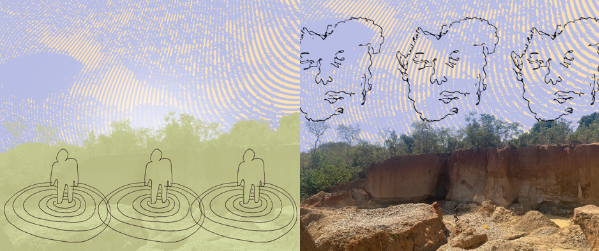
Zoë Viñas Crutcher, Reminders of Relation.
What insight might relational thinking add to the proposition that alternatives to extractivism entail a kind of healing? Healing broken landscapes, people, and other living and non-living entities becomes a matter not of ‘patching up’ broken entities but of restoring vital relationships. How can these broken relationships be revealed when colonial mindsets that attribute agency only to humans have so thoroughly hidden them from view?
This manifesto deliberately seeks to work with relational modes of being and knowing, and thus to perform a particular onto-epistemic politics.
Crucially, these questions highlight the co-constitution of ontology and epistemology: How we know renders some worldings visible and some invisible. In turn, the world(s) we can see shape(s) what we may come to know. This, in turn, has political implications, such as which modes of living we can conceive of, and which do we perceive as possible or impossible. This manifesto deliberately seeks to work with relational modes of being and knowing, and thus to perform a particular onto-epistemic politics. Our inspirations include work by Viveiros de Castro, Deborah Danowski, Sylvia Wynter, which replace the one-world-world’s homo-economicus – who sees life and nature in terms of monetary value and power, making data and calculations the only way to understand reality – with the figures of ‘Terrans’, ‘Companion Species’ or ‘Making Kin’, that is, relationally-constituted beings who inhabit a planet that is historical, flowing and chaotic (de Castro and Danowski 2018; Haraway 2008 and 2016). Here, landscapes are not only resources; they are far more than hegemonic extractive language would suggest (Kimmerer 2013; de la Cadena 2015).
2. Spatial and Temporal Politics
Research on extractivism and alternatives is situated in particular spaces and times, with concomitant political implications.
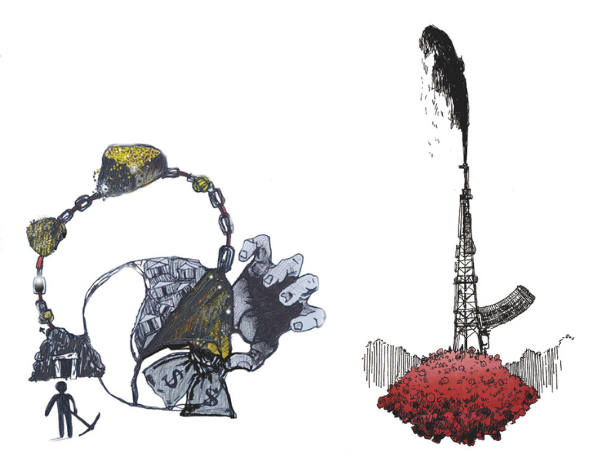
Left — Walter Zand, Developer Chain; Right — Luís Santos, Confliction
Seemingly innocent spatial and temporal markers, like ‘where’ and ‘when,’ have political implications when they unintentionally direct our attention to some extractivisms and alternatives rather than others. Such spatialities and temporalities expose priorities of visibility, action and marginalisation. We call for explicit attention to these spatial-temporal politics of knowledge. In this regard, it is important to note that the universalism that underpins much global governance research and practice simultaneously invokes a sense of urgency based on shared responsibilities (“we’re all in it together”) and tends to obscure conflict and difference across place (de Hoop et al. 2022). Meanwhile, opposing the ‘Global North’ and ‘Global South‘ to overcome the limits of this depoliticized ‘universalized global’ risks taking the colonial encounter as a given. And in seeking to identify the perpetrators and victims of global capitalism, extractivisms and injustices, we may, furthermore, overlook more complex dynamics. Other spatial conceptualisations – value chains, commodity frontiers, situated local ‘places’, a locally-produced global, connected localities or a world of worlds – each also come with their own politics of knowledge (Tsing 2005; Lyons 2020).
The same holds for temporal conceptualizations: linear time is entangled with paradigmatic concepts such as development and economic growth, while other notions of time such as cyclical time, the Braudelian relational plurality of social durations (longue durée/ conjuncture/ évenément), or cultural memory each come with their own politics of knowledge (Rao 2020). For example, research that is temporally framed around transitions to sustainability often represents radical change as the only route from an unsustainable present to a sustainable future (Priebe 2021). In contrast, research on ‘silent’ or ‘quiet’ sustainability highlights how the ‘transitions’ temporal frame and associated solutionist thinking diverts attention away from, and potentially undermines everyday ‘resource-light’ practices to policies in favour of future-oriented high-tech or ecomodernist solutions (see, for example, Smith and Jehlicka 2013; Straeten van der 2022). Contrary to such technological fixes, notions of geological deep time unsettle our understanding of human histories and political categories, calling for new political imaginations which attend to planetary processes and other-than-human lives (Chakrabarty 2021).

Zoë Viñas Crutcher, Extraction to Waste.
The foregoing raises questions about the (in)visibilities produced by spatial and temporal politics: What is rendered visible? What remains hidden? In light of our first proposition that ontologies and epistemologies inform one another, we can read these questions in two ways. How do different ways of knowing – spatial and temporal conceptualizations – entail or render visible possibilities for extractivist and/or alternative becoming? And how do spatial and temporal becomings inform ways of knowing? With these questions, we propose being mindful of the politics that spatial and temporal frames perform in understandings of extractivisms and search for alternatives, and of the ways in which potential alternatives may give rise to more helpful spatial and temporal frames. Attending to these dynamics is not merely an academic exercise, but a critical intervention in how extractive realities are legitimised or contested, and how alternatives may be imagined and sustained.
Finally, in light of Puig de la Bellacasa’s (2015: 709) call for ‘making time for soil time’ – to which we would add ‘soil-space’, which may similarly weave together diverse spatialities (see, e.g. Teaiwa 2015; Van der Vleuten and De Hoop 2025) – we propose to explore how diverse temporalities and spatialities and their associated worldings may come to thrive and coexist.
3. Interwoven Alternatives to Extractivism
Considering extractivism and its alternatives together seeks to transcend binaries, to open space for questions and other ways of doing, and to make the complexity of urgencies visible.
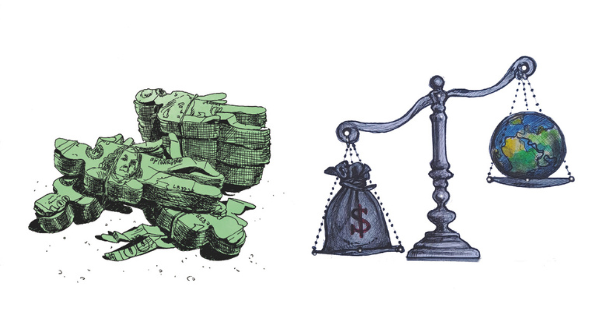
Left — Luís Santos, Capital; Right — Walter Zand, Winners and Losers
By examining how extractivism as a concept emerged and developed, we can better situate our exploration of alternatives in current scholarly debates. One genealogy can be traced to Latin America (Gudynas 2009), where the concept of extractivismo first emerged as a critique of capitalism and neoliberalism among 1990s grassroots left-wing movements such as the Neo-Zapatista uprising in Chiapas, Mexico and the alter-globalism of the World Social Forum (Riofrancos 2019). Influenced by Marxist and neo-Marxist political economy approaches, extractivism came to be understood as the large-scale, industrialised extractive exploitation of natural resources in the interests of capital accumulation, often far away from the sites of extraction. The concept has been instrumental in revising histories of exploitation, explaining contemporary inequalities and injustices, and denouncing its destructiveness to the environment (Gudynas 2015, 2018; Gómez-Barris 2017).
In recent decades, the concept has spread and been deployed around the world (for example, to Africa, see Finkeldey 2022). The concept has been enriched with finer-grained analyses, for example, of its gendered aspects and implications (e.g. Pereira and Tsikata 2021) and its various forms, for example, neo-extractivism (Svampa 2019; Arboleda 2020), agrarian extractivism (Veltmeyer and Ezquerro-Cañete 2023), carbon extractivism (Behrends, Reyna and Schlee 2011), epistemic extractivism (Grossfoguel 2016), and green extractivism (Bruna 2022; Dunlap et al. 2024). The latter has been legitimised and encouraged by fashionable narratives of ‘sustainable development’ and ‘energy transition’ (Kronenburg García and Wiegink 2024).
To move beyond generalities and grand narratives, we propose a processual and relational understanding of extractivism as ‘resource-making process’.
To move beyond generalities and grand narratives about capitalism, global flows, ‘natural resources’ and towards a more grounded and ‘undergrounded’ understanding of extractivism that recognizes the web of human and other-than-human relations in places of extraction, we propose a processual and relational understanding of extractivism as a ‘resource-making process’ (Richardson and Weszkalnys 2014). This conception draws attention to the large quantities of material substances that are extracted (or produced) from the (sub)soil and turned into commodities and wealth – ‘natural resources’ – that are ‘channelled away’ (Pereira and Tsikata 2021), or rather ‘drained’ (Bruna 2022), from those closest to, and most harmed by, the extractive activities. The other-than-human ecologies from which they have been removed are left scarred and contaminated; the human livelihoods with which they are entangled destroyed, and the existing relations between humans and other-than-humans, cuerpo-territorio or body-territory (Zaragocin and Caretta 2021; see Proposition 5 below), seen or unseen living and non-living entities, severed and broken. In short, extractivist projects typically destroy life-sustaining relations.
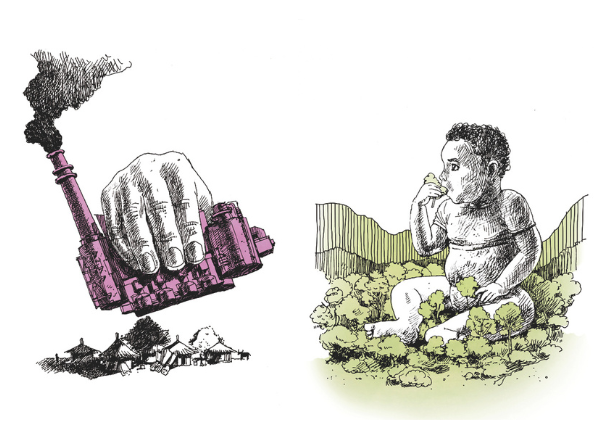
Left — Luís Santos, Displacement; Right — Luís Santos, Our Nature
Extractivism is predicated upon capitalist competition, profit-making, and a view of certain people as ‘surplus’ (Wiegink and Kronenburg García 2022; Geenen and Gleiberman 2023) and ‘disposable’ (Lesutis 2019), of underground substances and materials as ‘dead matter’ (Luning 2022), and of certain places as ‘sacrifice zones’ (Klein 2014). It is a socio-ecological way of relating based on subjugation, depletion, and non-reciprocity (Chagnon et al. 2022).
The words ‘death’, ‘suffocation’, ‘existential threat’ and ‘violence’ often evoke the affective and visceral dimension of extractivism. These qualifiers resonate with some of the ways the consequences of extractivism are described by, for example, people (about to be) displaced from their homes in places of extraction in northern Mozambique : ‘I am just waiting to die’, or ‘it is as if we are put into a mass grave’ (Wiegink and Kronenburg García 2022), calling to mind incisive analyses by authors such as Francoise Vergès (2021) and Gargi Bhattacharyya (2024) of the racialised, classed and gendered hierarchies of worth that shape notions of who and what is expendable as well as people’s own sense of belonging.
If extractivism is about dying, death and suffocation, then alternatives should be about living, life and breathing – the universal right of all life to breathe (Mbembe and Shread 2020). Alternatives would then be about seeing the Earth as life affording, about care. They would also be about dying well – without the fear that bones will be tilted, extracted, displaced, or disrespected in the name of capital gain.
However, suggesting alternative ways of being, knowing and doing can be a red flag: it risks reproducing the colonising potential of romanticisation (Bawaka Country et al. 2018). Additionally, we should not forget that people facing extractive projects in their home areas often also talk about hope for a better life, of getting a job, better healthcare, roads and benefiting from ‘development’ more generally (Matusse 2023; Verweijen et al. 2024). And life is also made on and alongside the ruins of extractivism: people produce food on contaminated land, reappropriate materials and ‘waste,’ and reclaim and repair scarred landscapes. How can we navigate these tensions?
Mol and colleagues (2010) suggest describing the doing of care as ‘practical tinkering’ that entails an ‘attentive experimentation’ (p.13) about how different goods might coexist in (a given, specific) practice. Zuiderent-Jerak (2015) uses the notion of ‘situated intervention’ to describe a mode of social scientists’ direct involvement in what they study: a practice of collaborative experimentation to further scholarly understanding. We can think of this kind of work as a micropolitical undertaking of learning ‘how to act in the midst of ongoing, unforeclosed situations and experiment with the ways of discerning and tending to the ‘‘otherwise’’’ (Anderson 2017: 593). With respect to the latter, Arora and Van Dyck (2021) attend to instances of radical care enacted in refusals of modern industrial agricultural tools such as genetically modified seeds or electronic tagging of livestock. What these moments of refusal have in common is the adoption of an alternative direction, producing ‘other arrangements of the possible’ (Hartman 2019: 302). They ‘point to the pluralization of ways of relating with neglected or vulnerable others in societies and ecologies’ (Arora and Van Dyck 2021: 255, emphasis in original).
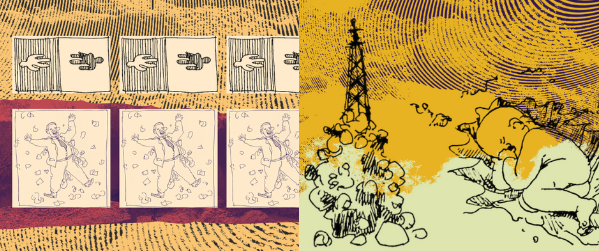
Zoë Viñas Crutcher, In the Wake Of. Sketches by Luís Santos; photographs taken by Esther Miedema, mining site, northern Mozambique
Climate change and the rapid loss of biodiversity evoke a sense of urgency: ‘action now!’. Yet neither ‘attentive experimentation’ nor ‘practical tinkering’ call for hasty decisions or conclusions. We heed Haraway’s (2016: 1) call to stay with the trouble, ‘as mortal critters entwined in myriad unfinished configurations of places, times, matters, meanings’ (see also Casolo et al. 2022).
Chakrabarty’s (2021) perspective on the planetary – on habitability instead of a narrowly defined sustainability – leads us to ask how we can draw attention to alternatives while remaining mindful of their possible (unintended) consequences. We have no definitive answer to this question: ‘just transitioning’ to alternative sources of energy has too often proven not very ‘just’ in terms of social justice, often following a logic similar to that which underpins extractivist endeavours (Curley 2018, Howe and Boyer 2016; Bainton et al. 2021; Arora et al. 2025; Otchere-Darko and Weszkalnys 2025). The central point of this manifesto must remain opaque. Alternatives can be found in the experimental, in the specific, in instances of radical care enacted in ‘quiet sustainabilities’ and in the ‘no.’ None of this lets international politics off the hook. It is intended as a reminder of the matter’s complexity, not to minimise its urgency.
4. Struggles and Subversive Spaces: Narratives, (Cosmo)Politics, and Actors
Attending to alternatives demands that we locate attempts to subvert extractivist constellations and possibilities to forge alliances.
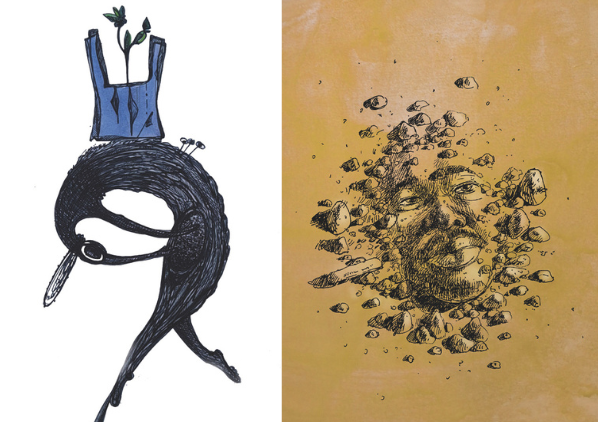
Left — Walter Zand, Sustainability; Right — Luís Santos, Belong
We need to pay attention to what exists alongside or grows at current and former extractivist sites and projects, as Tsing (2015) does in ‘Mushroom… on the ruins of capitalism’. Sites of subversion, co-existence and (re)growth can develop around those living inside extraction zones who seek to resist the dispossession and appropriation of their land and resources. These sites may also include global, digital and multi-locality networks whose warnings provoke political action (Mühlebach 2023). Relationships between humans and other-than-humans and knowledge formations that challenge or oppose capitalist understandings of nature as ‘resources’ offer examples of such subversion. Stengers (2005) has inspired proposals for a cosmopolitics, drawing our attention to a variety of gatherings of participants with different ontological locations, positions or epistemics (Blaser and de la Cadena 2018; Bacigalupo et al. 2024). Others have focused on how other-than-humans become the material and discursive frames through which communities engage in modern politics that could bring a change of order, including our understanding and practice of politics (Bacigalupo et al. 2024).
In this perspective, subversive scaling involves convening potential human and other-than-human allies and moving beyond the physical sites of extraction and resistance into larger connectivities. Such scaling can turn human and other-than-human bodies into subversive sites that respond to injustice, mark difference, or signal a refusal (Simpson 2014; Arora and Van Dyck 2021) of dominant worldings.
Subversion does not aim to reverse the systems of power and knowledge underpinning extractivism in any straightforward or simplistic sense, or to undo the past or return to some prior state. Instead, it often implies modes of restoration and repair, seeking to ‘irritate,’ to shift the grounds of what is at stake.
Subversion does not aim to reverse the systems of power and knowledge underpinning extractivism in any straightforward or simplistic sense, or to undo the past or return to some prior state. Instead, it often implies modes of restoration and repair, seeking to ‘irritate’, to shift the grounds of what is at stake. ‘The master’s tools may never dismantle the master’s house’ (Lorde 1984), but we still aim, alongside our activist interlocutors, to do more than just rearrange the furniture.
Attending to alternatives and diverse forms of subversion means revising and transcending established critical theories of power: contra Foucault, we must reach for what lies outside of power and bring it into the realm of what is possible. The power of extractivist constellations does not lie simply in the distribution of capital or (quasi)military force; its forms of violence comprise the epistemic and ontological, the world of desire and the imagination (Winchell and Howe 2024: 203). Conversely, subversions of power – always situated in specific places, bodies, and times – are not necessarily built on acts like reversing conventional property rights or political participation, but on opening epistemic space.
To gather participants with different ontological locations, positions or epistemics in the form of “cosmopolitics” raises the question as to who or what constitutes the common world, the latter a possible – inconclusive and temporary – result rather than a starting point (Laclau, 1990). This line of thinking – and feeling – requires an understanding of how such a lens might sensitise us to spaces of subversion, co-existence or re-growth. Who or what could we forge alliances with?
5. Methodological considerations
Studying extractivism calls for multifaceted approaches that draw on diverse disciplinary perspectives, methodologies and tools.
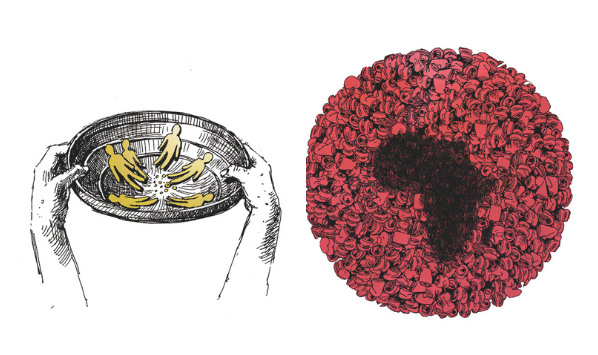
Left — Luís Santos, Wasteland; Right — Luís Santos, Death Toll
Extractivism unfolds across multiple temporalities, leaving indelible traces on landscapes, human bodies, cultures, multispecies relationships, and Earth itself. Some methodologies and tools to understand it include tracing financial flows, mapping contamination and pollution, documenting degraded landscapes and human and other-than-human health and wellbeing, and exploring various archives, including oral histories and memories (Canham 2023). For example, Latin American feminist collectives working against extractivist projects developed cuerpo-territorio (body-territory) to facilitate storytelling and analysis of territorial conflicts. This process conceptualises the body as the main site in which gendered, classed and racialised experiences of and in the world converge (Guzman Narváez 2022) and can serve not only as a diagnostic method but also a practice of care that (re)embodies relationships with land (Zaragocin and Caretta 2021).
These perspectives imply that research methods should not only expose the harmful effects of neoliberalism and extractivism on people and environments but also reshape collective imaginaries to bridge the divide between humans and other-than-humans that they have deepened.
We can also think about archives in multispecies terms. For example, soil studies suggest both horizontal and vertical views, which both entail decisions about scope. Krzywosynska et al. (2020) argue that place-based knowledge of the soil should extend far beneath our feet: for example, one might ask ‘how deep is a farm?’. This allows for stronger links between knowledge and practice in specific places. Scholars such as Kate Rigby (2022) suggest that Western societies could benefit from reclaiming Romanticism’s reverence towards nature (though not its binary opposition between nature and humans) rather than seeing it as a resource for extracting wealth (Moore 2015). These perspectives imply that research methods should not only expose the harmful effects of neoliberalism and extractivism on people and environments but also reshape collective imaginaries to bridge the divide between humans and other-than-humans that they have deepened (Knox 2020).
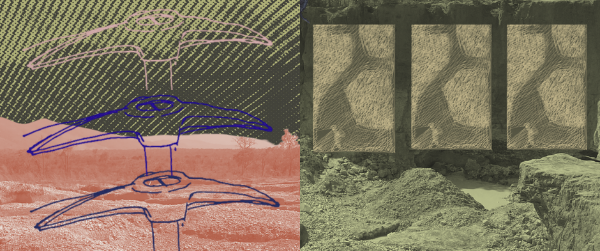
Zoë Viñas Crutcher, Mine Etchings.
We propose the term ‘co-labouring’ not only to describe how researchers can, for example, work with miners or farmers to gain deeper understanding of the(ir) underground (despite linguistic and conceptual hurdles) but also how they can collaborate with artists (Fisher et al. 2023). Nii Obodai’s (2023) work demonstrates the experimental nature of co-labouring through art and how such processes generate social ties, creating a space for people to express their concerns and illustrate possible futures.
Collaboration with artists, musicians, filmmakers, and other creative practitioners can further engage people’s heads, hands, and hearts (Sutoris 2022), fostering a deeper connection to multispecies and ecological relationships. Importantly, such an approach can challenge the discredited notion that incomplete knowledge is the primary barrier to change and that simply providing information will alter behaviours (see also Weszkalnys et al. forthcoming). Engaging with a combination of methodologies that embody relational commitments with multispecies ecologies can foster a more e/affective approach than those that primarily focus on data collection for the sake of knowledge production.
Many of our methodological questions remain open, as ‘resolving’ them would depend on (among other things) the specific forms of extractivism and alternatives. For most researchers, coming to an understanding of diverse ways of being may be the most methodologically complex; what sensibilities must researchers foster to notice what they might be missing or obscuring? Additionally, what sensibilities are needed to better communicate ‘the other story, the untold one, the life story’ (Le Guin 2019: 33)?
Unresolved questions
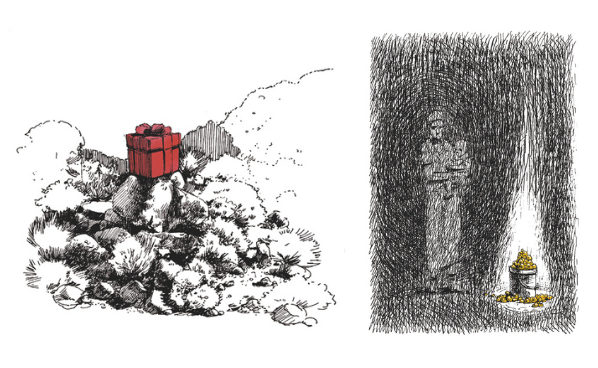
Left — Luís Santos, Present; Right — Luís Santos, Out of Sight
REPAIRING BROKEN RELATIONSHIPS
What insight might relational thinking add to the proposition that alternatives to extractivism entail a kind of healing? Healing broken landscapes, people, and other living and non-living entities becomes a matter not of ‘patching up’ broken entities but of restoring vital relationships. How can these broken relationships be revealed when colonial mindsets that attribute agency only to humans have so thoroughly hidden them from view?
SPATIAL AND TEMPORAL (IN)VISIBILITIES
Content and conceptualisation are often implicitly or unreflectively entwined. Together, they raise questions about the (in)visibilities produced by spatial and temporal politics. What is rendered visible? What remains hidden? In light of our first proposition that ontologies and epistemologies inform one another, we can read these questions in two ways. How do different ways of knowing – spatial and temporal conceptualizations – entail or render visible possibilities for extractivist and/or alternative becoming? And how do spatial and temporal becomings inform ways of knowing?
NAVIGATING TENSIONS INHERENT TO ALTERNATIVES TO EXTRACTIVISM
If extractivism is about dying, death and suffocation, then alternatives would be about living, life and breathing – the universal right of all life to breathe. It would be about seeing the Earth as life affording, about reciprocal care. It would also be about dying well. However, we should not forget that people facing extractive projects in their home areas often also talk about hope for a better life, of getting a job, and receiving ‘development.’ And life is also made on and alongside the ruins of extractivism. How can we navigate these tensions?
Chakrabarty’s (2021) perspective on the planetary – on habitability instead of a narrowly defined sustainability – leads us to ask how we can draw attention to alternatives while remaining mindful of their possible (unintended) consequences.
EXPLORING THE COSMOPOLITICAL LENS
To gather participants with different ontological locations, positions or epistemics in the form of “cosmopolitics” raises the question as to who or what constitutes the common world, the latter a possible – inconclusive and temporary – result rather than a starting point. This line of thinking – and feeling – requires an understanding of how such a lens might sensitise us to spaces of subversion, co-existence or re-growth. Who or what could we forge alliances with?
METHODOLOGICAL SENSIBILITIES
Many of our methodological questions remain open, as ‘resolving’ them would depend on, among other things, the specific forms of extractivism and alternatives. For most, understanding diverse ways of being may be the most methodologically complex; what sensibilities must researchers foster to notice what they might be missing or obscuring? What sensibilities are needed to better communicate other stories?
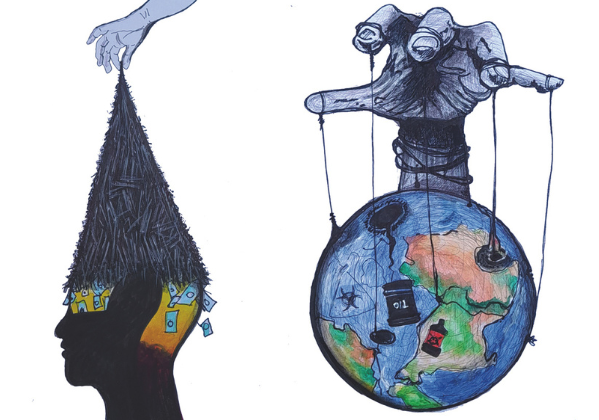
Left — Walter Zand, Who Profits; Right — Walter Zand, Damages Extractivism
On refusals and not-documenting
The ecological crisis we face inspires researchers to investigate, map, document and disseminate everything that might possibly contribute to redressing the harm done by the many forms of extractivism. However, we wish to conclude with a final unresolved question: what should be left unsaid, undocumented and unmapped? Here, we draw on ideas including the right to opacity and narratives of refusal. These acknowledge and accept that life and lives can never be fully understood (Glissant 1990) and speak to refusals of the modalities of transparency central to academic research (Simpson 2014).
Of the language we use to describe the other-than-human world around us, MacFarlane (2015: 32) observes that ‘we need to know how nature proceeds, […] but we need also […] to provide celebrations of not-quite-knowing, […] of excess.’ Citing Barry Lopez (2006), MacFarlane continues that ‘something emotive abides in the land, and . . . it can be recognised and evoked even if it cannot be thoroughly plumbed’ (ibid.).
Lopez’s ‘something’ refers to an otherness which remains outside of knowing and (thus) control. What might happen if we accept that some things are inaccessible to us (as researchers, as people)? In refusing efforts to fully know, understand and rationalize, might space be created for the less heard or noticed (Spivak 1988; Ferdinand 2023)?
If we seek to mobilise ‘many hands on deck’ to counter extractivism, we also need to be aware of the limits of research and question to what and whose end we research, document and disseminate.
And might practicing ethnographic restraint in the face of silence or a ‘refusal’ (to share, to participate in research) be a means to attend to and resist, in Deborah Thomas’ words (2024: 93) ‘the ongoing coloniality and racism that constitute the afterlives (and still lives) of conquest (see also Reese 2019; Arora and Van Dyck 2021)? If we seek to mobilise ‘many hands on deck’ to counter extractivism, we also need to be aware of the limits of research and question to what and whose end we research, document and disseminate. Instead, we might have to move towards suggestions of unthinking internalised legacies (Singh 2018) and stepping up against or rejecting ‘modernist’ behaviour that destroys the planet (Machado de Oliveira 2021) – through or outside academic knowledge production.
Meditating on unasked questions and imagination, Ursula K. Le Guin observes:
‘To me, the important thing is not to offer any specific hope of betterment but, by offering an imagined but persuasive alternative reality, to dislodge my mind, and so the reader’s mind, from the lazy, timorous habit of thinking that the way we live now is the only way people can live. It is that inertia that allows the institutions of injustice to continue unquestioned.’ (2004: 218)
As researchers, we might follow Le Guin whilst being critical of the dominant ‘we-s’ typically heeded (see also Chua and Mathur 2018). By using our imagination – posing the next question, applying all our senses to connect and illuminate diverse possibilities and the plurality of human and other-than-human ‘we-s,’ and resisting claims to certainty – we might contribute more fully to generating other stories.
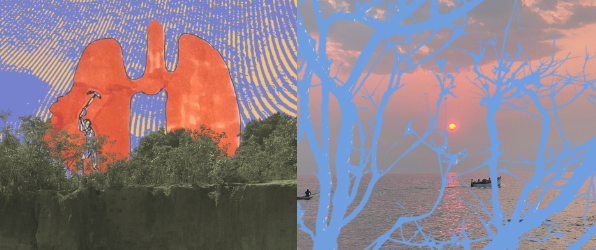
Zoë Viñas Crutcher, Futurities. Sketches by Luís Santos; photographs taken by Esther Miedema, northern Mozambique
Text by Esther Miedema, Andrea Behrends, Ruy Blanes, Carla Braga, Evelien de Hoop, Sara Geenen, Augustine Gyan, Angela Kronenburg García, Boitumelo (Tumi) Malope, Anselmo Matusse, Erik van der Vleuten and Gisa Weszkalnys.
Artwork by Tehua Dessenoix, Luís Santos and Walter Zand.
Collage and design by Zoë Crutcher.
Featured image: Luís Santos, With Every Strike.
Acknowledgements
We would like to acknowledge the invaluable input given by many in the development of this manifesto. Particular thanks to those who have provoked our thinking and supported us along the way: Saurabh Arora, Anna Mariella Bacigalupo, Natacha Bruna, Isabel Casimiro, Katya Chavel, Sabelo Ndlovu Gatsheni, Paulo Guambe, Elísio Jossias, Sabine Luning, José Jaime Macuane, Paula Meneses, Faustin Maganga, Anésio Manhiça, Jacob Mapossa, Ribeiro Nhambi, Nii Obodai, Charmaine Pereira, Quiseria Toalha, Asta Vonderau, Nikkie Wiegink and Leianne Wijnhoud. We are grateful to the financial support offered by Enabel, the Foundation for the History of Technology (SHT) and the DFG Point Sud programme. Many thanks to Daniel Flaumenhaft for his fantastic editing support.
Notes
- In Le Guin’s novel, Mishnory is the capital city of the nation Orgoreyn on the planet Gethen. ↩︎
- For more background see on the A2E initiative, see: Alternatives to Extractivism. ↩︎
- We refer to the German Research Foundation-funded ‘Point Sud’ workshop held in February 2024: ‘Alternatives to extractivism: ways of being-doing-knowing alongside (sub)surfaces in Mozambique and beyond.’ ↩︎
- All collages by Zoë Crutcher build on sketches by Luís Santos and photographs taken by Esther Miedema near various mining sites in northern Mozambique. ↩︎
References
Anderson, B. (2017). Hope and micropolitics. Environment and Planning D: Society and Space, 35(4), pp. 593–595.
Arboleda, M. (2020). Planetary Mine: Territories of Extraction under Late Capitalism. London: Verso.
Arora, S., Ghosh, B., and A. Stirling (2025). Decolonising Innovation for Pluriversal Justice in Sustainability Transitions.
Arora, S. and B. Van Dyck (2021). Refusal as Radical Care? Moving Beyond Modern Industrial Agriculture. Development 64, pp. 252–258.
Bacigalupo, A.M., Manrique, C.A., and C. McAllister (2024). Introduction: The Flesh of Justice in Latin America = Introducción: La Carne de la Justicia en América Latina. American Religion 5(2), 1-18.
Bainton, N., D. Kemp, E. Lèbre, J.R. Owen, and G. Marston (2021). The energy-extractives nexus and the just transition. Sustainable Development: pp. 1–11.
Baptista, I. and L. R. Cirolia (2022). From problematisation to propositionality: Advancing southern urban infrastructure debates. Transactions of the Institute of British Geographers, 47, pp. 927–939.
Bawaka Country, Wright, S., Suchet-Pearson, S., Lloyd, K., Burarrwanga, L., Ganambarr, R., Ganambarr-Stubbs, M., Ganambarr, B., Maymuru, D., and M. Graham (2018). Everything is love: Mobilising knowledges, identities, and places as Bawaka. In: Nicole Gombay and Marcela Palomino-Schalscha (eds). Indigenous Places and Colonial Spaces, Routledge, London, pp. 51–71.
Bear, L. (2016). Time as Technique. Annual Review of Anthropology, Vol. 45, pp. 487-502.
Beckert, S., Bosma, U., Schneider, M., and E. Vanhaute (2021). Commodity frontiers and the transformation of the global countryside: a research agenda. Journal of Global History, 16.3 (2021), pp. 435–450.
Behrends, A., Reyna S., and G. Schlee (2013). Crude domination. Towards an anthropology of oil. Berghahn.
Bhattacharyya, G. (2024). The futures of racial capitalism. Polity.
Braga, C., E. de Hoop, A. Kronenburg-Garcia, E. Miedema. A. Pase and M.Pepa. 2025. Ways of Being-Knowing and doing with water and land in Africa. In Water and Land in the Sahel: mapping the flow. Eds. A. Pase et al. London: Routledge
Butler, J. (2010) Frames of War. When is Life Grievable? London:Verso
Canham ka, H. (2023). Riotous Deathscapes. Duke University Press.
Casolo, J., Flores, S., and N. Gonda (2022). Choosing to ‘“stay with the trouble’”: A gesture towards decolonial research praxis. Undisciplined Environments.
Chagnon, C. W., Durante, F., Gills, B., Hagolani-Albov, S., Hokkanen, S., Kangasluoma, S., Konttinen, H., et al. (2022). From Extractivism to Global Extractivism: The Evolution of an Organizing Concept. The Journal of Peasant Studies, 49 (4), pp. 760–92.
Chakrabarty, D. (2021). The Planet: A Humanist Category. The Climate of History in a Planetary Age. Chicago London: The University of Chicago Press, pp. 68–94.
Chua, L., and N. Mathur (Eds., 2018). Who are “We”?: Reimagining Alterity and Affinity in Anthropology (1st ed., Vol. 34). Berghahn Books.
Cork, S., Alexandra, C., Alvarez-Romero, J., Bennett, E., Berbes-Blazquez, M., Bohensky, E., Bok, B., Costanza, R., Hashimoto, S., Hill, R., Inayatullah, S., Kok, K., Kuiper, J., Moglia, M., Pereira, L., Peterson, G., Weeks, R., and C. Wyborn (2023). Exploring alternative futures in the Anthropocene. Annual Review of Environment and Resources, 48, pp. 25–54.
Curley A. (2018). A failed green future: Navajo green jobs and energy “transition” in the Navajo Nation. Geoforum, 88, pp. 57–65.
de Castro, E. V., and D. Danowski (2018). Humans and Terrans in the Gaia war. A World of Many Worlds, pp. 172–203.
De Hoop, E., Sridhar, A., da Silva, C. M., and E. Van der Vleuten (2022). Historicising Entanglements: Science, Technology and Socio-Ecological Change in the Postcolonial Anthropocene. Global Environment 15(2), pp. 195–208.
de la Bellacasa, M. P. (2015). Making Time for Soil: Technoscientific Futurity Pace of Care. Social Studies of Science, 45.5, pp. 691–716.
de la Cadena, M. (2015). Earth beings: Ecologies of practice across Andean worlds. Duke University Press.
De Sousa Santos, B. and M. P. Meneses (2010). Epistemologias do Sul. São Paulo, Cortez.
Dunlap, A. and J. Jakobsen (2020). The Violent Technologies of Extraction. Political Ecology, Critical Agrarian Studies and the Capitalist Worldeater. Springer International Publishing.
Dunlap, A., Verweijen, J., and C. Tornel (2024). The Political Ecologies of ‘Green’ Extractivism(s): An Introduction. Journal of Political Ecology, 31 (1), pp. 436–63.
Escobar, A. (2017). Designs for the pluriverse: radical interdependence, autonomy, and the making of worlds. Duke University Press.
Ferdinand, M. (2023). Decolonial Ecology. Thinking from the Caribbean World. Polity Press.
Finkeldey, J. (2022). Fighting Global Neo-Extractivism: Fossil-Free Social Movements in South Africa. London and New York: Routledge.
Fisher, E., Luning, S., and N. Obodai (2023). Gold matters. Visualizing mining worlds. Uppsala, The Nordic Africa Institute.
Geenen, S. and M. Gleiberman (2023). Superfluous jobs in extractive industries. The usefulness/uselessness of job creation after dispossession. Work, Employment and Society, 37(2), pp. 394–411.
Gómez-Barris, M. (2017). The Extractive Zone: Social Ecologies and Decolonial Perspectives. Dissident Acts. Durham, NC: Duke University Press.
Granjou, C. and G. Meulemans (2023). Bringing soils to life in the human and social sciences, Soil Security, 10.
Granjou, C. and J. F. Salazar (2016). The Stuff of Soil. Belowground Agency in the Making of Future Climates. Nature and Culture, 14, 1, pp. 39–60.
Green, L. (2020). Rock | Water | Life. Ecology and Humanities for a Decolonial South Africa. Duke University Press.
Grossfoguel, R. (2016). Del «extractivismo económico» al «extractivismo epistémico» y al «extractivismo ontológico»: una forma destructiva de conocer, ser y estar en el mundo. Tabula Rasa, 24.
Gudynas, E. (2015). Extractivismos: ecología, economía y política de un modo de entender el desarrollo y la naturaleza. CEDIB, Centro de Documentación e Información Bolivia.
Gudynas, E. (2009). Diez tesis urgentes sobre el nuevo extractivismo. Extractivismo, política y sociedad, 187, pp. 187–225.
Guzman Narváez, N. (2022). Embodied Geographies: Feminist Body-Mapping with Amazonian Indigenous Girls, Cuerpo-Territorio, and the Outlining of a New Academic Grammar. Portal.
Hamouchene, H. (2023). Dismantling Green Colonialism: Energy and Climate Justice in the Arab Region. Pluto Press.
Haraway, D. (2008). When species meet. University of Minnesota Press.
Haraway, D. (2016). Staying with the Trouble. Making Kin in the Chthulucene. Duke University Press.
Howe C. and D. Boyer (2016). Aeolian extractivism and community wind in southern Mexico. Public Culture, 28(2), pp. 215–235.
Katz C. (1996). Towards minor theory. Environment and Planning D: Society and Space 14, pp. 487–499.
Klein, N. (2014). This changes everything: capitalism vs the climate. Simon and Schuster.
Kronenburg García, A. and N. Wiegink (2024). Mining the Energy Transition: An Introduction. Anthropological Quarterly, 97(2), pp. 311–27.
Krzywosynska, A., Banwart, S., and D. Blacker (2020). To Know, To Dwell, To Care: Towards an Actionable, Place-based Knowledge of Soils. In: Salazar et al. (eds). Thinking with Soils. Material Politics and Social Theory. London: Bloomsbury Academic, pp. 89–106.
Knox, H. (2020). Thinking like a climate: governing a city in times of environmental change. Duke University Press.
Laclau, E. (1990). Antagonism and Dislocation: New Reflections on The Revolution of Our Time. London: Verso.
Lancione, M. (2017). Micropolitical entanglements: Positioning and matter. Environment and Planning D: Society and Space, 35(4), pp. 574–578.
Le Guin, U.K. (2019) The Carrier Bag Theory of Fiction. Ignota.
Le Guin, U. K. (2004). The Wave in the Mind. Talks and Essays on the Writer, the Reader and the Imagination. Shambala Publications.
Le Guin, U. K. (1969). The Left Hand of Darkness. Ace Books.
Lesutis, G. (2019). The non-politics of abandonment: Resource extractivism, precarity and coping in Tete, Mozambique, Political Geography, 72, pp. 43–51.
Luning, S. (2022). Underground. In: D’Angelo, L. and R. Pijpers (eds). The anthropology of resource extraction. Routledge.
Lyons, K. M. (2020). Vital Decomposition. Soil Practitioners and Life Politics. Duke University Press
Machado de Oliveira, V. (2021). Hospicing Modernity: Facing Humanity’s Wrongs and the Implications for Social Activism. Berkeley, California: North Atlantic Books.
MacFarlane, R. (2019). Underland. A Deep Time Journey. Penguin Books.
MacFarlane, R. (2015). Landmarks. Penguin Books.
Matusse, A. (2023). “Extractive Enchantment:” Unveiling the Dynamics of Resource Governance in Mozambique. Kujenga Amani (ssrc.org).
Matusse, A. (2018). “Radical Bricoleurs”: On doing science, community life, activism and bureaucracy in Mozambique. Engagement Blog.
Mbembe, A. and C. Shread (2021). The Universal Right to Breathe, Critical Inquiry, 47:S2, pp. 58–62.
Mignolo, W. D. (2007). Introduction. Coloniality of power and de-colonial thinking. Cultural Studies, 21 (2-3), pp. 155-167.
Mol, A., Moser, I. and J. Pols (2010). Care: putting practice into theory. In: Mol, A., Moser, I., and J. Pols (eds.), Care in Practice. On Tinkering in Clinics, Homes and Farms. Transaction Publishers, London, pp. 7–26.
Moore, J. (2015). Capitalism in the Web of Life: Ecology and the Accumulation of Capital. Verso Books.
Mühlebach, A. (2023). A Vital Frontier. Water Insurgencies in Europe. Duke University Press.
Murove, M. F. (2009). An African environmental ethic based on the concepts of ukama and ubuntu. In: Murove, M. F. (ed.) African Ethics: An Anthology for Comparative and Applied Ethics. Scottsville, South Africa: University of KwaZulu-Natal Press.
Ndlovu-Gatsheni, S. (2021). The cognitive empire, politics of knowledge and African intellectual productions: reflections on struggles for epistemic freedom and resurgence of decolonisation in the twenty-first century. Third World Quarterly, 42(5), pp. 882–901.
Otchere-Darko, W. and G. Weszkalnys (2025). Granite City Sunset: Uncommoning the Energy Transition. Environment and Planning D: Society and Space, 0(0): pp. 1–21.
Plataforma DECIDE (2025). Preliminary report on the post-electoral context in Mozambique (accessed on 20/02/2025).
Pereira, C. and D. Tsikata (2021). Contextualising Extractivism in Africa. Feminist Africa, 2(1), pp. 14–47.
Povinelli, E. (2011). Economies of Abandonment: Social Belonging and Endurance in Late Liberalism. Durham, NC and London: Duke University Press.
Price, C. and S. Chao (2023). Multispecies, More-Than-Human, Nonhuman, Other-Than-Human: Reimagining idioms of animacy in an age of planetary unmaking. Exchanges: The Interdisciplinary Research Journal, 10(2), pp. 177–193.
Priebe, J, Mårald, E. and A. Nordin (2021). Narrow pasts and futures: how frames of sustainability transformation limit societal change. Journal of Environmental Studies and Sciences, 11(1), pp. 76–84.
Puig de la Bellacasa, M. (2019). Re-animating soils: Transforming human–soil affections through science, culture and community. The Sociological Review, 67(2), pp. 391–407.
Puig de la Bellacasa, M. (2015). Making Time for Soil: Technoscientific Futurity Pace of Care. Social Studies of Science, 45(5), pp. 691–716.
Rao, R. (2020). Out of Time. The Queer Politics of Postcoloniality. Oxford University Press.
Ramose, M. (2009). Globalização e Ubuntu. In: B. Sousa Santos e P. Meneses (eds). Epistemologias do Sul. Coimbra: Almedina.
Reese, Ashanté. 2019. Refusal as care. Anthropology News, 60(3), pp. e135–e138.
Richardson, T. and G. Weszkalnys (2014). Introduction: Resource Materialities. Anthropological Quarterly, 87(1), pp. 5–30.
Rigby K. (2022). Reclaiming Romanticism: Towards an Ecopoetics of Decolonization. London: Bloomsbury Academic.
Riofrancos, T. (2019). What Comes After Extractivism? Dissent, 66, 55–61.
Salazar, J. F., Granjou, C., Kearnes, M. Krzywoszynska, A., and M. Tironi (eds., 2020). Thinking with Soils. Material Politics and Social Theory. London: Bloomsbury Academic.
Scott, J. C. (1999). Seeing like a State: How Certain Schemes to Improve the Human Condition Have Failed. Yale University Press.
Schrader A. (2015). Abyssal intimacies and temporalities of care: How (not) to care about deformed leaf bugs in the aftermath of Chernobyl. Social Studies of Science, 45(5), pp. 665–690.
Singh, J. (2018). Unthinking Mastery. Dehumanism and Decolonial Entanglements. Duke University Press.
Spivak, Gayatri Chakravorty (1988). Can the Subaltern Speak? Die Philosophin, 14(27), pp. 42–58.
Straeten, J. van der (2022). Sustainability’s “Other”: Coming to Terms with the Electric Rickshaw in Bangladesh. Historical Social Research, 47(4), pp. 139–167.
Sutoris P. (2022). Educating for the Anthropocene: Schooling and Activism in the Face of Slow Violence. Boston: MIT Press.
Svampa, M. (2019). Neo-Extractivism in Latin America: Socio-Environmental Conflicts, the Territorial Turn, and New Political Narratives. Element. Cambridge: Cambridge University Press.
Tamale, S. (2020). Decolonization and Afro-Feminism. Dajala Press.
Teaiwa, K. (2015). Ruining Pacific Islands: Australia’s Phosphate Imperialism. Australian Historical Studies, 46(3), pp. 374–391.
Thomas, D. A. (2024). Refusal (and Repair). Annual Review of Anthropology, 53(1), pp. 93–109.
Van der Vleuten, E. and E. De Hoop (2025). Plural pasts, plural futures: Considerations for transnational, transformative, and transdisciplinary histories of socio-material-ecological change In: Carnino, G., Disser, A., Hilaire-Pérez, L., Lamy, J., and A. Marrec (eds). Les techniques ont-elles une patrie? Paris: Presses des Mines.
Veltmeyer, H. and A. Ezquerro-Cañete (2023). Agro-extractivism, The Journal of Peasant Studies, 50(5), pp. 1673–1686.
Vergès, F. (2021). A Decolonial Feminism. Pluto Press.
Verweijen, J., Geenen, S., and A. Bashizi (2024). Articulating sedimented subjectivities: Extractive subject formation in eastern DRC. Geoforum, 148, p. 103652.
Watts, V. (2013). Indigenous Place-thought and Agency amongst Humans and Non-Humans (First Woman and Sky Woman Go on a European World Tour!). Decolonization: Indigeneity, Education and Society, 2(1), pp. 20–34.
Weszkalnys, G. (2023). Resource materialities, temporalities, and affects. In: Behzadi, N. E., Doering, N., and S. Postar (eds). Extraction/Exclusion: Beyond Binaries in Resource Knowledge and Practice. Lanham: Rowman and Littlefield, pp. 174–181.
Weszkalnys, G., Zećo, M., Otchere-Darko, W., and R. Grant (forthcoming). Listening to Energy Transition: An Undisciplined Intervention. Resistance: A Journal of Radical Environmental Humanities.
Wiegink, N. and A. Kronenburg García (2022). Surplus to Extraction: Resettlement as a ‘Make Live’ Intervention in Mozambique. The Extractive Industries and Society, 101036.
Wilson, M. J. (2019). The importance of parent material in soil classification: A review in a historical context. Catena, p. 182.
Zaragocin, S. and Caretta, M. A. (2021). Cuerpo-Territorio: A Decolonial Feminist Geographical Method for the Study of Embodiment. Annals of the American Association of Geographers, 111(5), pp. 1503–1518.
Zuiderent-Jerak, T. (2015). Situated Intervention: Sociological Experiments in Health Care. Inside Technology. MIT Press.
Abstract: In response to our present socio-ecological juncture and an effort to participate in a different kind of academia, we – a collective of academics and artists – co-laboured to develop a propositional manifesto as a way of thinking-feeling about ‘alternatives to extractvism’ (A2E). While embedded in existing scholarship, the manifesto does not seek to provide a ‘state of the art’ review, break new ground or provide fully articulated certainties. Instead, it poses questions to hint at ways of thinking-feeling about collaborative methodologies that more broadly attend to diverse ways of being, knowing and doing with humans and other-than-human critters and formations, with a particular emphasis on (sub)soils. This manifesto is (thus) composed not of theses, but propositions.
After a brief reflection on soil, we turn to our first two propositions, bringing together conceptual work on epistemic considerations and on space and time. The third proposition is a modest attempt to explore what extractivism and its alternatives might be, and the fourth and fifth delve into the real-life and methodological struggles of seeking alternatives. Our words are accompanied by artwork created during an A2E workshop (Mozambique, 2024) and a series of collages developed subsequently. The artworks pose their own questions, showing our points of departure from the perspective of engaged artists in Mozambique and beyond. We conclude with a reflection on the value of not-knowing and ethnographic restraint. Ursula K. Le Guin’s is but one of many sources of inspiration, her speculative fiction challenging – urging, tickling – us to use our imagination.